
French Drains That Send the Water Somewhere Else. For Good.
Standing water, soggy lawns, and wet basements all have the same cure. We design and install French drain systems across Central New York that put the water where it belongs: away.
Your Yard Keeps Telling You Where the Water Goes
Water always wins the argument. If your property is not moving it somewhere on purpose, it is going somewhere on its own, and in Central New York that somewhere is usually one of these:
The Swamp That Never Dries
That low spot where the grass squishes into June, the mower gets stuck, and the kids track mud in from a yard that has not seen rain in a week.
The Basement That Weeps
Damp corners after every storm, that musty smell you have stopped noticing, and a sump pump working overtime because water is pressing on the foundation.
The Clay Soil Bathtub
Much of Onondaga County sits on heavy clay that barely absorbs water. Rain and snowmelt sit on top of it like a sealed bathtub, right where your lawn is.
The Winter Ice Sheet
Every wet spot in fall becomes an ice sheet by December. Walkways, driveways, and patios downstream of bad drainage turn into hazards for five months.
How a French Drain Actually Works
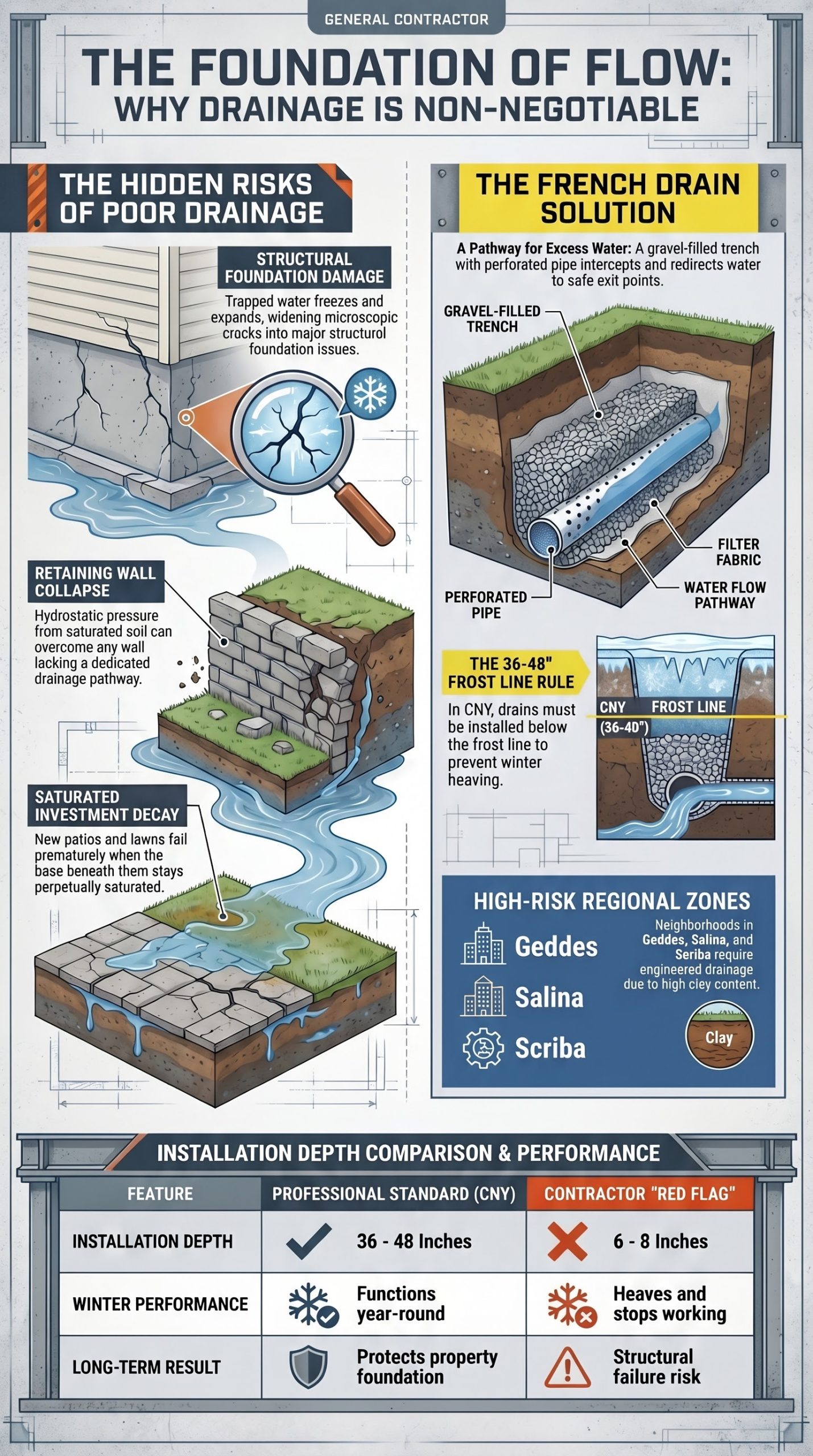
A French drain is beautifully simple: give water an easier path than your lawn or your foundation, and it will take that path every single time. The engineering is in getting each layer right.
- The trench, cut on grade. Sloped consistently so water flows the moment it enters. Get the pitch wrong and the whole system is an expensive ditch.
- Filter fabric lining. The unsung hero in clay country. It keeps fine soil particles from silting up the stone and pipe, which is how cheap installs die young.
- Washed drainage stone. Clean, angular stone creates the open voids water moves through. Round or dirty stone packs tight and defeats the purpose.
- Perforated pipe, holes down. Water rises into the pipe from below and rides the slope away. Installed upside down, it barely works, and yes, we have dug up plenty installed upside down.
- A real discharge point. Daylight on a slope, a dry well, or a storm connection. Water has to have somewhere legitimate to go that is not your neighbor's yard.
Why French Drains Fail Here, and Why Ours Do Not
Central New York is genuinely hard on drainage systems. Heavy clay soils silt up unprotected stone. Frost reaches deep enough to shift shallow pipe. Lake effect snow delivers months of meltwater in a few warm weeks. A French drain built for a milder climate quietly fails here within a few seasons, so ours are built for this one:
- Trench depth and pipe placement planned around real frost behavior, not a generic spec sheet
- Full filter fabric envelope so clay fines never choke the stone or pipe
- Washed, properly sized stone with the voids that make the system actually drain
- Slope verified with instruments, not eyeballed off the lawn
- Discharge planned for spring melt volume, when the system earns its keep most
- Surface restored properly, so in a month you forget exactly where the trench ran
One System, Six Jobs It Does Around Your Property
Soggy Lawn Rescue
Intercepts surface and subsurface water in low spots and moves it out, so the swampy corner becomes lawn you can actually use.
Foundation Perimeter
Collects the water pressing against your basement walls and carries it away before it finds the crack it is looking for.
Downspout Tie-Ins
Your roof sheds an enormous amount of water at four concentrated points. We pipe it away underground instead of letting it pool at the foundation.
Driveway + Walkway Edges
Stops runoff from washing out edges, undermining pavement, and refreezing across the surfaces you walk and drive on all winter.
Behind Retaining Walls
Water trapped behind a wall becomes a hydraulic battering ram every winter. Proper drainage is the difference between a wall that holds and one that leans.
Under Future Hardscapes
The smartest time for drainage is before the patio goes in. We build both, so the water plan and the paver plan are one plan.
Your Foundation Feels Every Storm You Ignore
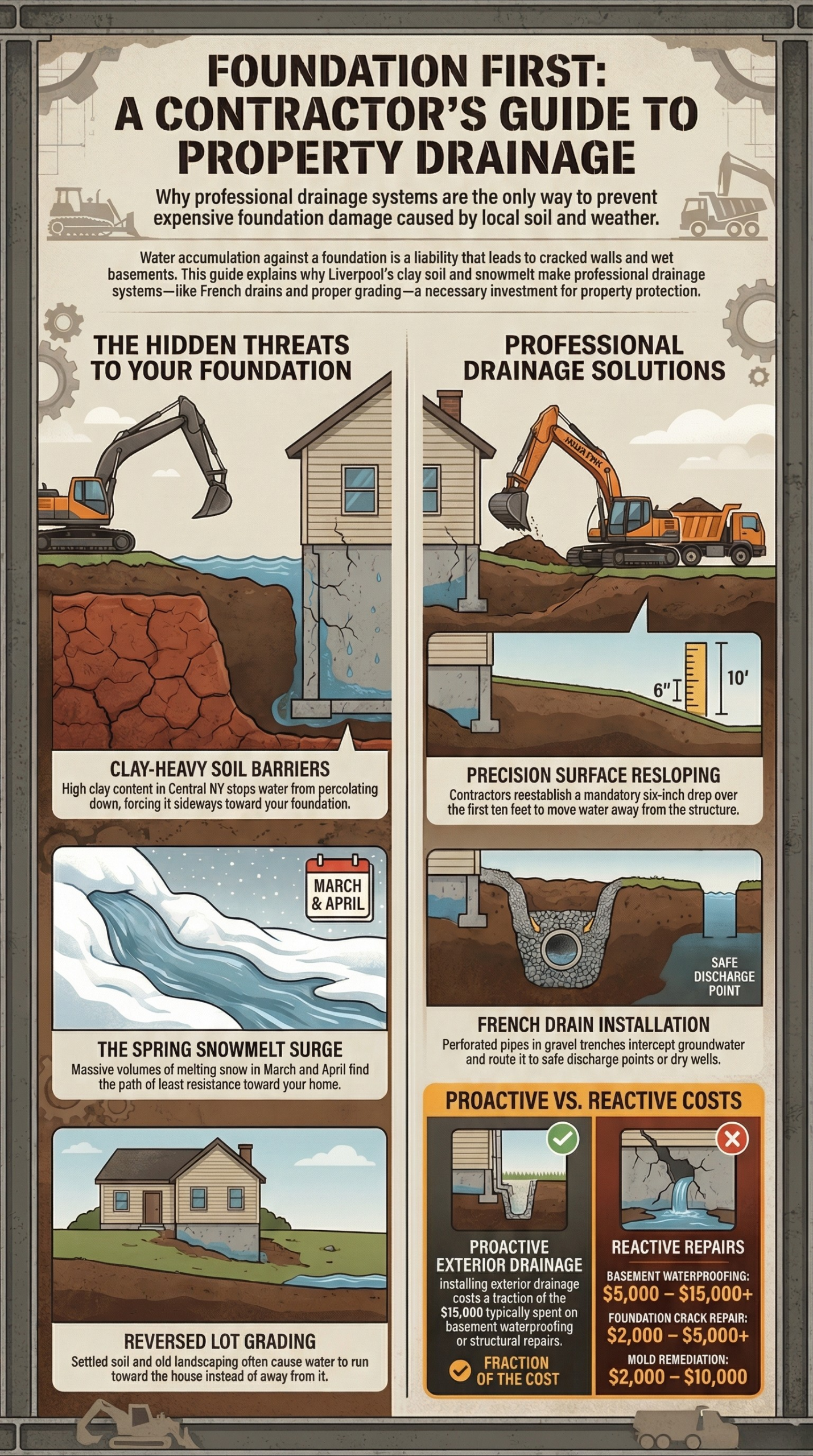
Every gallon of water that sits in the soil against your foundation is pushing on it. Engineers call it hydrostatic pressure; homeowners call it the damp wall, the hairline crack, and eventually the basement that floods every March. In Central New York the problem compounds, because months of accumulated lake effect snow melts in a matter of weeks, all of it looking for the path of least resistance, and clay soil holds it right against the concrete while it looks.
Foundation drainage flips the physics. A French drain system at the perimeter collects that water before pressure builds and carries it away from the house, which is why it belongs on the short list of the most valuable protective work you can do for the structure itself. The infographic breaks down exactly what is happening to an unprotected foundation and what proper drainage changes.
What Your Neighbors Say About Working With Us
Drainage work disappears underground the day it is finished. The results, and the reviews, are how you judge it.
From Standing Water to Solved in Four Steps
Reach Out
Call, email, or use our contact form. Tell us where the water shows up, when it is worst, and what it is threatening.
Site Visit
We walk the property, read the grades and soil, find where the water comes from and where it can legitimately go.
Clear Proposal
You get a written plan covering the drain route, discharge point, materials, timeline, and cost. No surprises.
We Install It
Trench, fabric, stone, pipe, discharge, and restoration. The next hard rain becomes the most satisfying weather report of your year.
French Drains, Answered Plainly
How do I know if I need a French drain or something else?
Follow the water. Standing water in the yard, a chronically damp basement, or erosion channels after storms usually point to a subsurface drainage problem a French drain solves. Sometimes the honest answer is different, like regrading, downspout extensions, or a combination. We diagnose during the site visit and recommend the fix that matches the actual problem, not the one we felt like selling.
Where does the water actually go?
Every system we design has a legitimate discharge point: daylighting on a downhill slope, a dry well that lets water soak into better soil away from the house, or a connection to existing storm drainage where available. What it never does is dump onto your neighbor's property, which causes exactly the kind of problem you can imagine.
Will installing one wreck my lawn?
There is no trench without digging, but there is a big difference between careful work and a war zone. We plan routes to minimize disruption, protect the surrounding turf, and restore the trench line with proper topsoil so it disappears into the lawn within weeks. Most customers cannot point to the route by the end of the season.
How long does a French drain last?
A properly built system is measured in decades. The failures you hear about almost always trace to skipped filter fabric, dirty stone, or bad slope, which is why the cheap install is the expensive one. Built right for clay soil, there is no regular maintenance beyond keeping the discharge point clear.
Does a French drain still work in winter?
Yes, and late winter is when it matters most here. The system sits below the surface where ground temperatures are more stable, and its biggest job of the year is the spring melt, when months of lake effect snow turns to water in a few weeks and every property in Central New York finds out whose drainage was real.
Can I just do this myself with a weekend and a rental trencher?
People do, and we have rebuilt a fair number of the results. The digging is the easy part. The parts that decide whether it works are the slope, the fabric, the stone selection, and the discharge plan, and each one is easy to get quietly wrong in clay soil. If you are set on DIY, our drainage master guide will at least help you avoid the classic mistakes. If you want it solved once, that is what we do.
Drainage Knowledge, Free for the Taking
Stop Arguing With Water. Start Routing It.
Free, no obligation estimates across Onondaga and Oswego Counties. Show us where the water shows up, and we will show you the plan that makes it someone else's weather.
Veteran Owned // Serving Central New York