
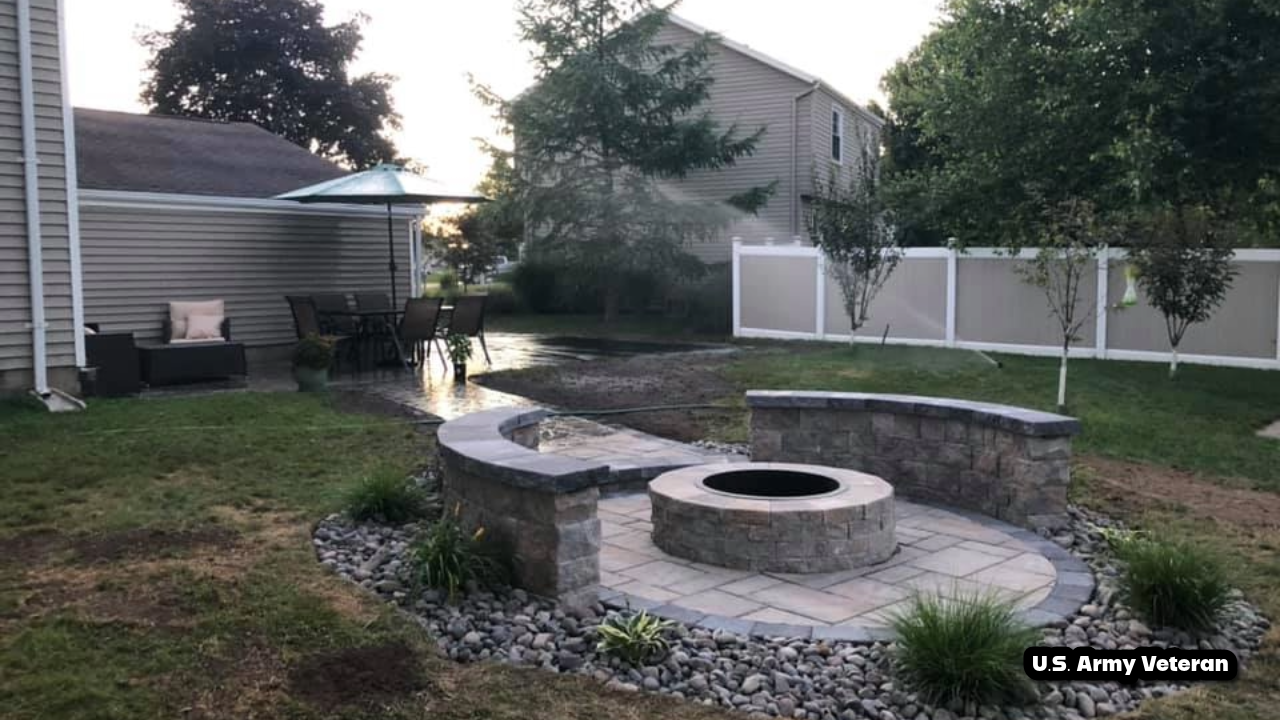
Bottom Line Up Front
If you live anywhere in Onondaga or Oswego County and your property has standing water, a deteriorating deck, an old pool, overgrown brush, eroded soil, or drainage problems that keep returning, those are not minor cosmetic issues. They are compounding structural and safety problems that get worse with every winter. Central New York’s freeze-thaw cycle, heavy snowfall, and clay-heavy soils turn small yard problems into expensive ones in a single season.
This guide walks through each of those problems in full, explains what causes them, and shows you what a professional solution actually looks like. Ground Force Property Services serves all of Onondaga and Oswego County — veteran-owned, and built on straight answers.
📋 What You Will Find in This Guide
- How Central New York’s Climate Punishes Properties
- 8 Warning Signs Your Yard Needs Professional Help
- French Drains and Drainage Solutions That Actually Work
- Old Pool Removal — Reclaiming Your Backyard
- Replacing a Rotting Deck with Premium Concrete Pavers
- Yard Excavation, Old Infrastructure, and Underground Utilities
- Brush Removal and Land Clearing
- Every Town in Onondaga and Oswego County — Local Challenges
Chapter 1: How Central New York’s Climate Punishes Properties
Most property problems in Onondaga and Oswego Counties do not start with a single catastrophic event. They start with something much quieter: a winter. Then another. Then ten more.
Central New York is not kind to outdoor structures, drainage systems, or yard infrastructure. The combination of heavy lake-effect snowfall, wide temperature swings, and clay-dense soil creates conditions that accelerate wear on every outdoor surface — wood decks, concrete slabs, drainage channels, pool walls, and graded soil alike. Understanding this climate is not background information. It is the foundation for every decision a property owner in this region needs to make about outdoor improvements.
The Freeze-Thaw Cycle Nobody Talks About
Here is what happens when temperatures in Central New York drop below freezing and then climb back above it — sometimes multiple times in the same week. Any moisture that has worked its way into a crack, a joint, a wood fiber, or a soil pocket expands as it freezes. When it thaws, it leaves a slightly larger gap than before. Repeat that process forty, fifty, or sixty times over a single winter, and what started as a hairline crack in a concrete patio becomes a trip hazard. A slightly soft patch under a deck footing becomes a full structural shift. A slow-draining corner of the yard becomes a chronically waterlogged zone that never fully dries out between rain events.
This is not theory. It is the standard experience for homeowners in Syracuse, Liverpool, Baldwinsville, Cicero, Clay, Manlius, Fulton, Pulaski, and every other community across both counties. The freeze-thaw cycle is the single biggest reason outdoor properties in this region age faster than they would in warmer climates, and it is the single biggest reason that shortcuts in drainage, base preparation, and materials selection cost property owners far more in the long run.
What This Means for Onondaga and Oswego County Homeowners
The practical implication is that property work in CNY needs to account for that climate at every stage — design, materials selection, installation depth, and drainage engineering. A French drain installed without proper gravel depth will heave in the first hard freeze. A wood deck not built with appropriate spacing between boards will rot faster because snow sits in those gaps from November through March. An old pool left in the ground with deteriorating walls becomes a collapse risk when frost pushes against the shell from all sides over years of neglect.
Professional property work here is not the same as professional property work in Virginia or Georgia. Central New York requires materials, grading specifications, and installation methods built for this climate specifically. That knowledge only comes from working in this region season after season — and it is exactly the kind of experience Ground Force brings to every project we take on.
📚 Related Guides on This Topic
Chapter 2: 8 Warning Signs Your Yard Needs Professional Help
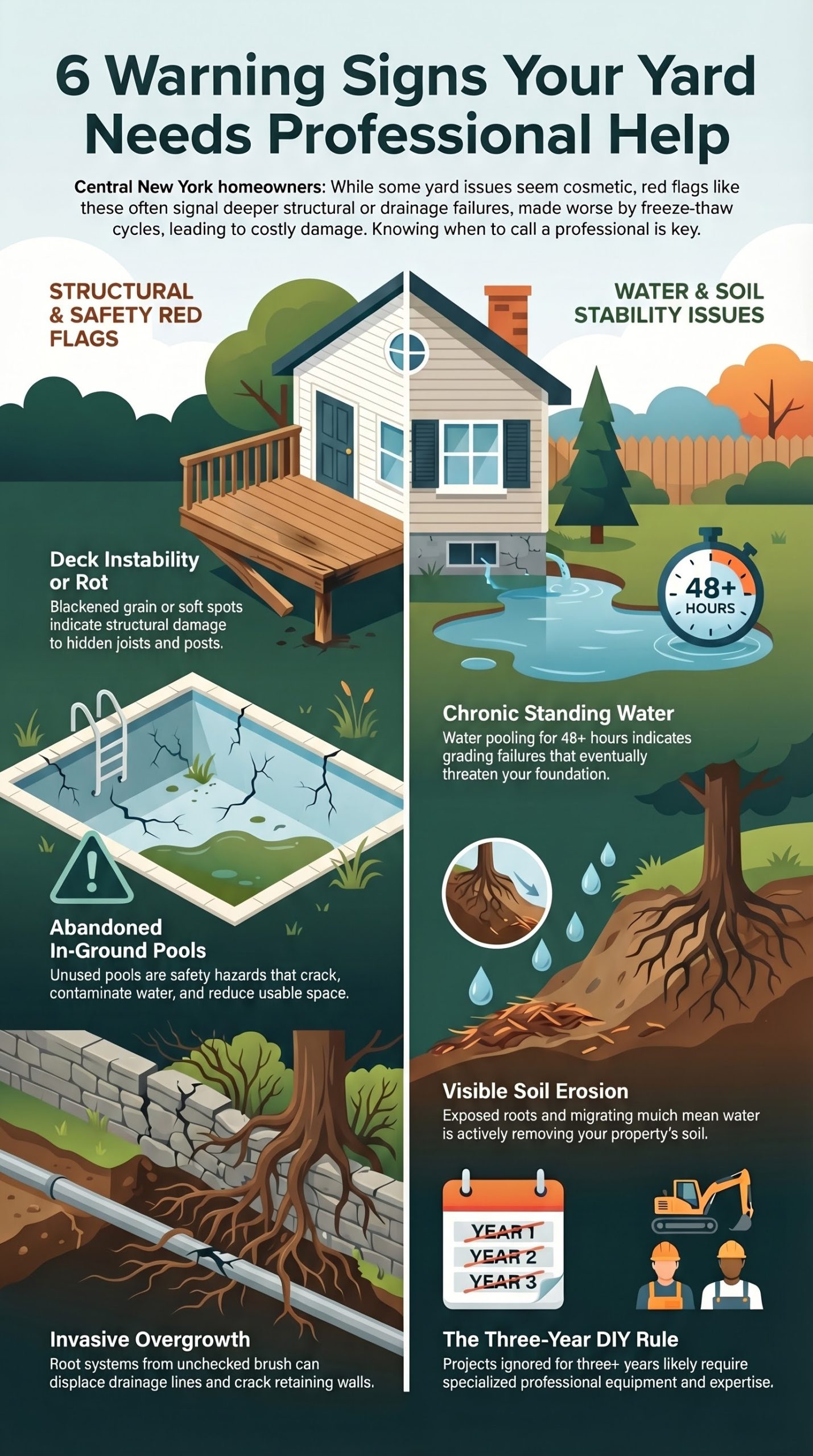
Most homeowners sense that something is off before they can put precise words to it. Here are the eight signs that tell you a problem has moved past the DIY stage — and why each one matters more in Central New York than it would almost anywhere else.
Warning Sign 1 — Water Pools in the Same Spot Every Time It Rains
If one area of your yard holds water for more than 24 to 48 hours after a rain event, that is a drainage problem. It is not a soil problem you can fix with a bag of topsoil. It is not something that will sort itself out over a dry summer. The grade is wrong, the soil is impermeable, or both. Left alone, that standing water becomes a mosquito habitat, kills grass, softens the soil beneath any nearby structure, and eventually finds a path toward your foundation. In the freeze-thaw context, it also means that pocket of saturated soil expands and contracts every time temperatures swing — and every swing does a little more damage to whatever is nearby.
Warning Sign 2 — Your Deck Wobbles, Sags, or Shows Soft Spots
A deck that moves when you walk on it, shows blackened wood grain, or has boards that give slightly when you press them with your foot is a safety problem — not a cosmetic one. Wood rot in a deck structure is rarely limited to the surface. By the time you can see and feel it, it has usually worked its way into the joists and posts that hold the structure together. In Central New York, this deterioration happens faster than most people expect. A deck installed in 2005 that has never been properly sealed or maintained may be structurally compromised today — especially if it faces north, stays shaded, or holds snow and ice from November through March.
Warning Sign 3 — An Old Pool Nobody Swims In
An unused in-ground pool is not a neutral presence on your property. It is a liability. The structure continues to age whether you use it or not. Walls can crack, the bottom can shift, the coping can separate, and the interior surface can deteriorate to the point where any water inside becomes contaminated. If you have children or grandchildren on the property — or neighbors with children nearby — a neglected pool is a safety hazard regardless of whether it is drained or covered. And every year you keep it, you are paying to maintain something that adds nothing to your life and actively reduces the usable square footage of your outdoor space.
Warning Sign 4 — Ground That Never Fully Drains
This one shows up as muddy tracks from the back door to the lawn, perennially wet grass near the foundation, or soil that stays spongy well into June. It is especially common in older neighborhoods in Solvay, North Syracuse, East Syracuse, Minoa, and Central Square, where the natural grade was altered during original development and never properly restored. It is also common in newer subdivisions in Clay and Cicero, where grading was done to minimum code and has shifted over the years.
Warning Sign 5 — Overgrown Brush, Brambles, or Unmaintained Trees
An overgrown yard is more than an eyesore. Dense brush and root systems from unchecked tree growth can displace drainage lines, crack retaining walls, push against fences, and create habitat for rodents and pests. Brambles and invasive species like Japanese knotweed and multiflora rose — both common in rural parts of Oswego County — spread aggressively once established and become significantly harder and more expensive to clear the longer they are left alone.
Warning Sign 6 — Visible Erosion Along Slopes or Garden Beds
If you can see exposed roots, bare soil running downhill, or mulch that migrates out of your planting beds every time it rains heavily, erosion is actively removing soil from your property. Over time, this destabilizes plantings, exposes buried infrastructure, and creates sloped surfaces that direct water toward your home instead of away from it. Retaining walls and proper regrading address this directly — and the sooner they go in, the less soil needs to be rebuilt afterward.
Warning Sign 7 — Structures That Belong to a Different Era
This one is less about immediate safety and more about quality of life and property value. If your backyard contains a crumbling concrete slab from the 1980s, a chain-link fence, a deteriorating above-ground pool that deflates every fall, and a shed with a rotting floor, your outdoor space is not working for you. It is not a place you want to spend time in. And when you eventually sell, buyers will price every one of those deferred problems out of their offer. A yard overhaul is a financial decision as much as a practical one.
Warning Sign 8 — You Have Been Going to Handle It for Three or More Years
This is the most honest one on this list. If a project has been on the list for three or more years and has not happened yet, it is not going to happen as a DIY project. The scope is too large, the equipment required is too specialized, or the time simply is not there. That is not a failure of motivation — it is just the reality of property ownership alongside a full life. The longer a structural or drainage problem waits, the more it compounds. A call to a professional is not an admission of defeat. It is the most efficient decision you can make with your time and your money.
📚 Related Guides on This Topic
Ready to Address Your Property?
Ground Force serves every town in Onondaga and Oswego County.
Free property assessments, no pressure, straight answers from a veteran-owned team.
Chapter 3: French Drains and Drainage Solutions That Actually Work
Drainage is the foundation of every other outdoor improvement. If water does not move properly through and off your property, every other investment — a new patio, a replanted lawn, a fresh retaining wall — is working against poor fundamentals. It does not matter how well a hardscape is installed if the base beneath it stays saturated. Getting drainage right first is the non-negotiable starting point.
What a French Drain Actually Does
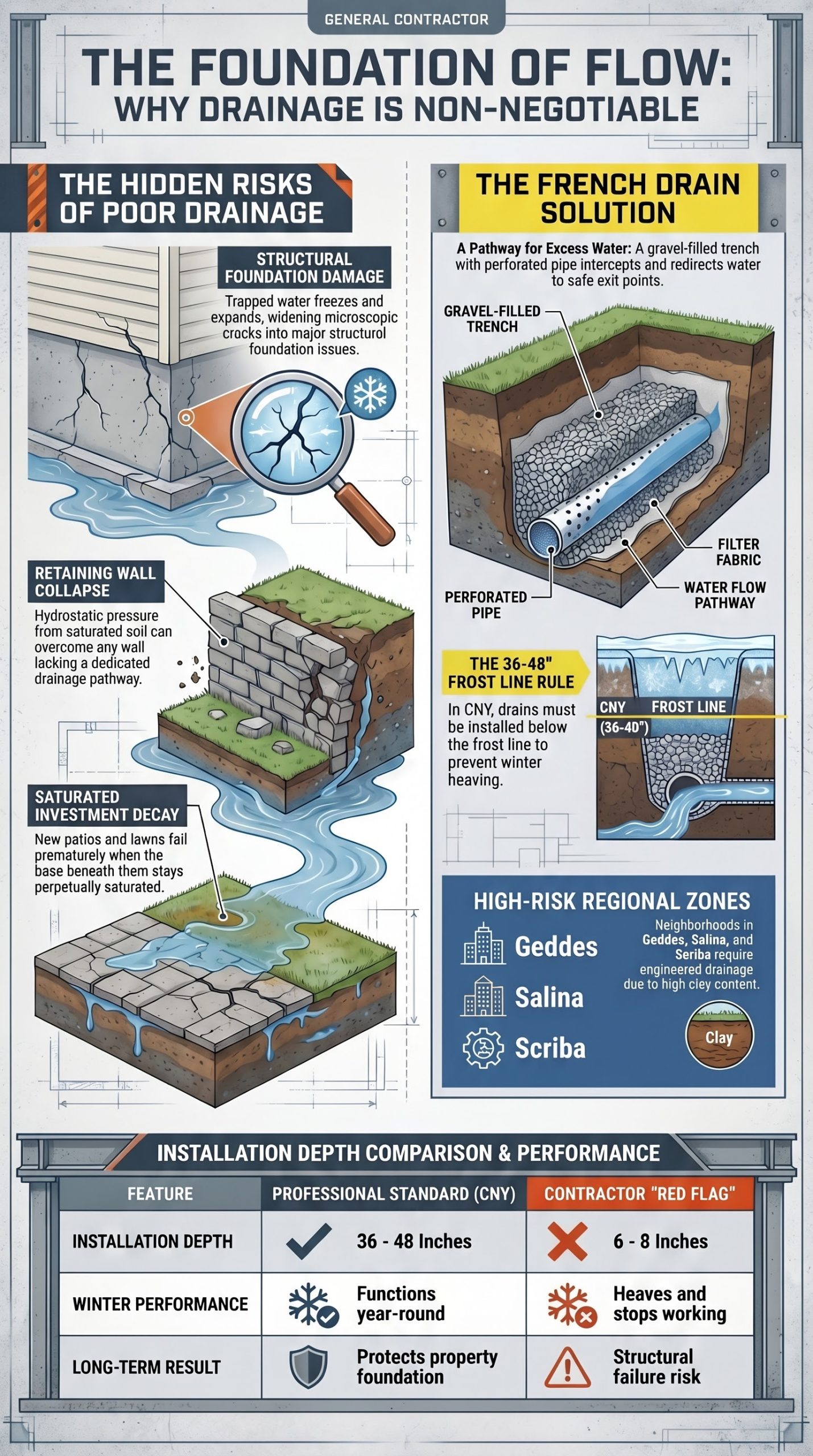
A French drain is a gravel-filled trench containing a perforated pipe. The trench intercepts groundwater or surface water and redirects it to a point away from the problem area — typically a street drain, a dry well, a swale, or a lower section of the property. The pipe sits in gravel, which filters sediment and provides a pathway for water to enter from all sides.
Properly installed, a French drain solves problems that feel permanent: the corner of the yard that floods every spring, the foundation wall that shows moisture every time it rains hard, the patch of grass that dies every year in the same spot because the roots are perpetually soaked. These are not isolated problems — they are symptoms of water with nowhere adequate to go. A French drain gives it a destination.
When Drainage Problems Become Structural Problems
Most homeowners underestimate how quickly a drainage issue can turn into a structural issue. Water that pools against a foundation wall eventually finds its way into microscopic cracks in the concrete. In a CNY winter, that water freezes, expands, and widens the crack. Repeat that over several winters and you have a foundation that is being actively damaged by water that should have been directed away from the house years ago.
The same principle applies to retaining walls. A wall without proper drainage behind it will fail — not because the wall was built poorly, but because the hydrostatic pressure from saturated soil will eventually overcome any wall that does not have a way to drain. Proper French drain installation behind retaining walls is not optional — it is part of what makes a wall last or not.
⚠️ French Drain Depth in Central New York
In Central New York, a French drain must be installed below the frost line — 36 to 48 inches in Onondaga and Oswego Counties — to function reliably year-round. A shallow installation will heave in the first hard freeze and stop working entirely. If a contractor proposes installing a French drain at six or eight inches depth in this climate, that is a red flag worth taking seriously.
Communities Most Affected by Poor Drainage
Communities built on or near former wetlands, lake plains, or areas with high clay content in the soil are especially prone to drainage problems. In Onondaga County, neighborhoods in Geddes, Salina, Van Buren, and the older sections of Camillus regularly deal with drainage issues tied to soil composition and relatively flat terrain. In Oswego County, low-lying areas near Lake Ontario — including Scriba, New Haven, Minetto, and parts of Volney — experience seasonal flooding that requires properly engineered drainage systems, not just surface grading improvements.
📚 Related Guides on This Topic
- French Drains and Drainage Systems in Onondaga and Oswego Counties
- The Master Guide to Proper Drainage Systems
- Protecting Your Liverpool, NY Home’s Foundation: The Importance of a Proper Drainage System
- 50 Reasons French Drains Help Avoid Property Damage
- 50 Basement Flooding Problems Without Proper Drainage
Chapter 4: Old Pool Removal — Reclaiming Your Backyard
Pool removal is one of the most transformative projects a homeowner in Central New York can undertake. An unused pool does not just occupy space — it dominates it. The surrounding area is typically paved, fenced, and unavailable for any other purpose. Remove it properly and you recover the entire backyard.
The Real Risk of Leaving an Old Pool in Place
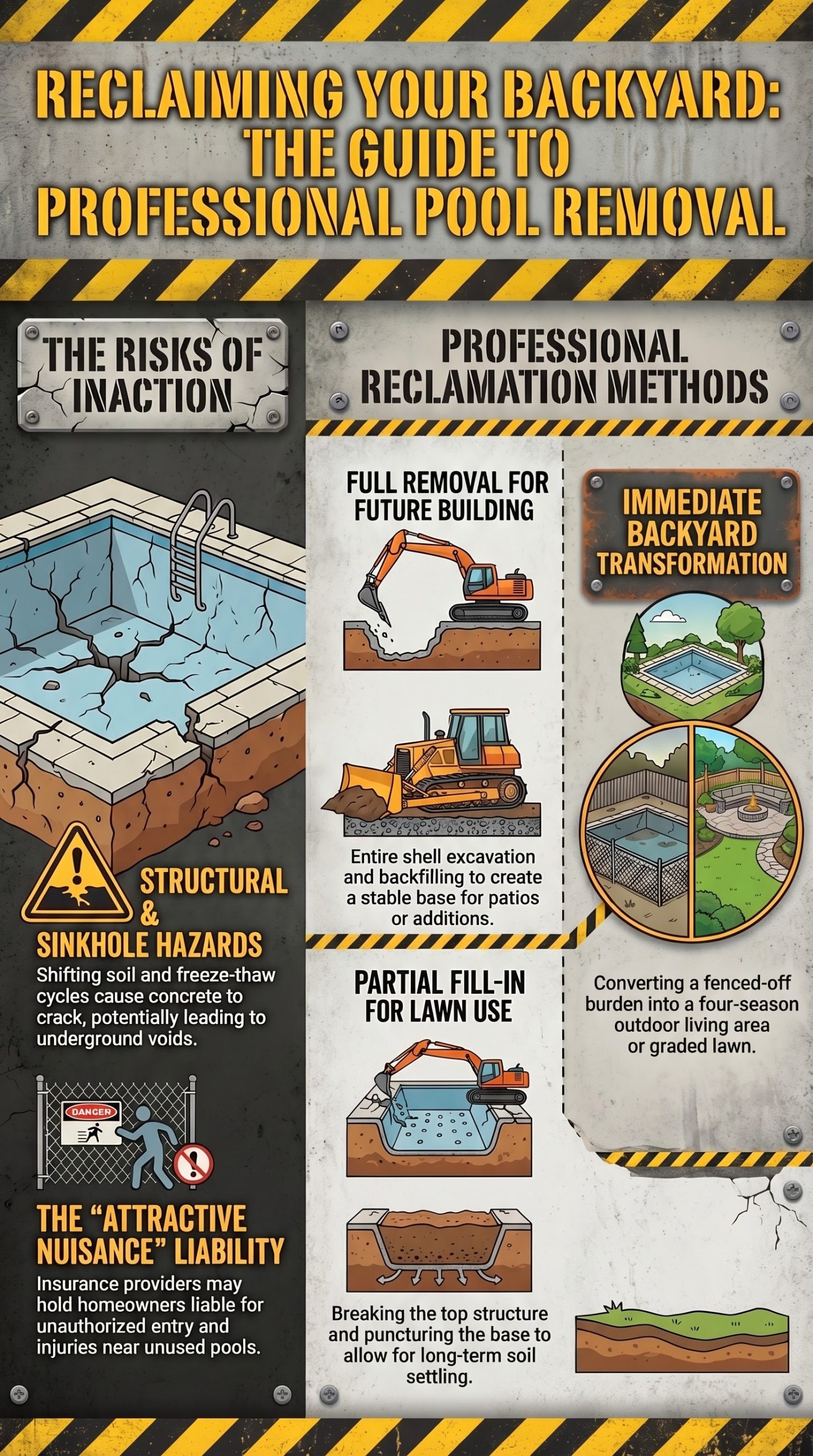
An aging in-ground pool presents several compounding risks. The concrete shell will crack over time as soil shifts and freeze-thaw cycles repeat. Once cracking begins, the pool can no longer hold water, which means any rain or snowmelt that enters the deteriorating shell has nowhere to drain — sitting against the compromised walls and accelerating structural breakdown. In more advanced cases, an old pool can create a void beneath the surface as the surrounding soil collapses inward, posing a genuine sinkhole risk that no fence or cover can prevent.
Insurance liability is another consideration that many homeowners do not consider until something goes wrong. Many homeowners’ insurance policies classify an unused in-ground pool as an attractive nuisance — a structure that is reasonably foreseeable to attract unsupervised entry, particularly by children. If someone enters your property and is injured in or near the pool, your liability exposure is significant regardless of whether the pool was covered or fenced.
Full Removal vs. Partial Fill-In
There are two approaches to pool removal: full removal, where the entire shell is excavated and the area is properly backfilled with compactable material; and partial removal, sometimes called pool abandonment, where the bottom of the shell is punctured for drainage, the top portion is broken down, and the structure is backfilled in place. Full removal is the right choice when the homeowner plans to build any structure over the former pool area — a patio, a hardscape, a lawn feature, or a future addition — because only full removal produces a stable, fully settled base. Partial fill-in is an acceptable option when the area will remain as lawn and the homeowner understands that the backfill area will take several years to fully compact and settle.
Ground Force performs both types of pool removal across Onondaga and Oswego Counties. In most cases, when the goal is to create usable outdoor living space, full removal is what we recommend — and we have the excavation equipment to do it properly and efficiently.
What Happens After the Pool Is Gone
The transformation after a pool removal is immediate and often dramatic. Homeowners who spent years working around an unused pool and its perimeter fence suddenly have an open backyard again. Most clients choose to replace that space with a combination of graded lawn and hardscape — a paver patio, a terrace, or an outdoor living area that functions through all four seasons. Others prefer a garden layout with a simple lawn restoration. Either way, the property stops being a burden and starts being something you actually want to spend time in.
📚 Related Guides on This Topic
- Old Pool Removal in Onondaga and Oswego Counties
- Partial vs. Full Pool Removal in Onondaga County
- Partial vs. Full Pool Removal in Oswego County
- What Cicero and Baldwinsville Homeowners Are Building Where the Old Pool Used to Be
- Your Pool Is Gone — Now the Best Part of Your Oswego County Backyard Starts
- Above-Ground Pool Removal in Onondaga County
- Above-Ground Pool Removal in Oswego County
- Inground Pool Removal in Onondaga County
- Inground Pool Removal in Oswego County
Chapter 5: Replacing a Rotting Deck with Premium Concrete Pavers
The single most common outdoor renovation we see in Central New York is the replacement of a deteriorating wood deck with a properly designed concrete paver patio. It is not a trend — it is the logical response to decades of watching wood perform poorly in this specific climate.
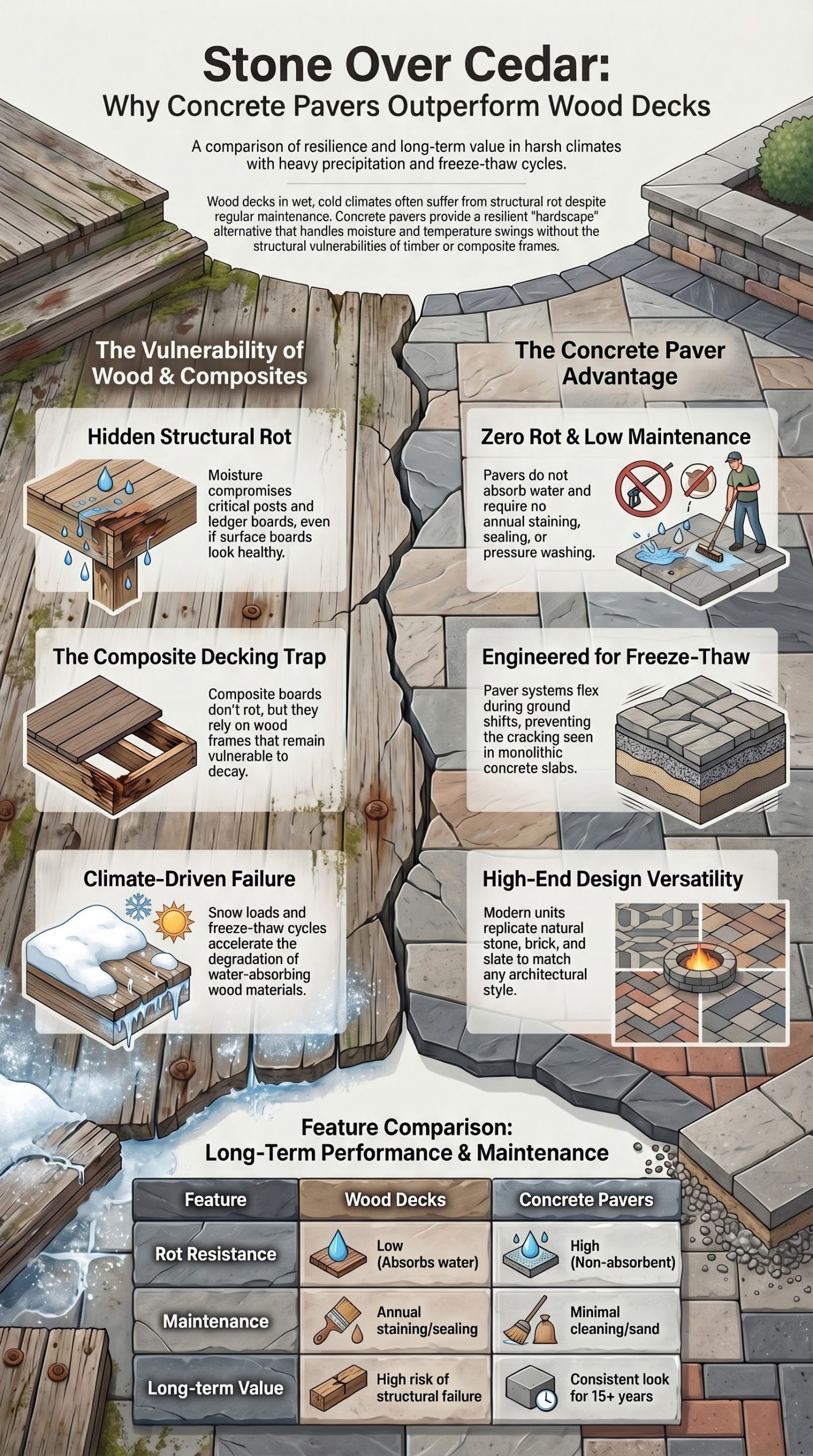
Why Wood Decks Fail in Central New York
Wood is a water-absorbing material. In a climate with significant precipitation, heavy snow loads, sub-zero temperatures, and wide seasonal humidity swings, even pressure-treated lumber will degrade faster than most homeowners expect. The failure is not just surface rot — it is structural rot in the posts, ledger boards, and joist hangers that actually hold the deck together. Once those components are compromised, the deck is a liability, not an amenity, regardless of how the boards look from a distance.
Composite decking has improved significantly over the years, but it still requires a wood substructure — and that substructure is subject to the same deterioration that affects any dimensional lumber in a wet, freeze-thaw climate. Composite boards do not rot, but the frame they sit on does. And that frame is what keeps the deck standing.
The Case for Concrete Pavers
Concrete pavers address almost every weakness of wood decking. They do not absorb water. They do not rot. They do not require annual sealing, staining, or pressure washing to maintain their structural performance. When a paver is damaged by frost heave or impact, you replace that individual unit — not the entire surface. And for CNY conditions specifically, concrete pavers with a properly compacted base and appropriate joint sand will flex through freeze-thaw cycles without cracking the way a monolithic concrete slab will crack.
The aesthetic range is also far wider than most homeowners realize before they start looking. Modern concrete pavers are available in formats that replicate natural stone, brick, slate, and flagstone — in a wide range of colors and textures suited to any architectural style. A well-designed paver patio in Liverpool, Fayetteville, Jordan, or Skaneateles will look as good in year fifteen as it did the year it was installed.
Design Options That Transform the Space
The best paver installations do more than replace what was there before. They reimagine how the outdoor space actually functions. A deck that was eight by twelve feet and sat right off the back door might be replaced with a broader paver terrace that incorporates a fire pit zone, a dining area, a smooth transition to the lawn, and built-in steps or a low retaining wall along the perimeter. The result is not just a new surface — it is a completely different relationship with the outdoor space behind your home.
Concrete Pavers vs. Wood Decking in Central New York
| Factor | Concrete Pavers | Wood Deck |
|---|---|---|
| Lifespan in CNY Climate | 25 to 50+ years | 10 to 20 years |
| Annual Maintenance | Minimal | Seal, stain, and inspect yearly |
| Frost Heave Response | Individual units reset easily | Can shift footings and framing |
| Water Damage Risk | Very low | High without regular sealing |
| Snow Removal | Easy — durable surface | Risk of gouge damage from shovels |
| ROI at Resale | Strong — adds usable living space | Moderate to low when aging |
📚 Related Guides on This Topic
- The Master Guide to Investing in Premium Concrete Pavers
- Paver Patios in Onondaga County, NY
- Paver Patios in Oswego County, NY
- Complete Hardscapes in Onondaga County, NY
- Complete Hardscapes in Oswego County, NY
- Concrete Pavers vs. Stamped Concrete in Onondaga County
- Paver Pool Deck Installation in Onondaga County
- Paver Pool Deck Installation in Oswego County
Chapter 6: Yard Excavation, Old Infrastructure, and Underground Utilities
Almost every significant yard project — pool removal, drainage installation, retaining wall construction, patio base preparation — involves some degree of excavation. And in both Onondaga and Oswego Counties, excavation always brings a major variable with it: what is already under the ground, and where exactly it is.
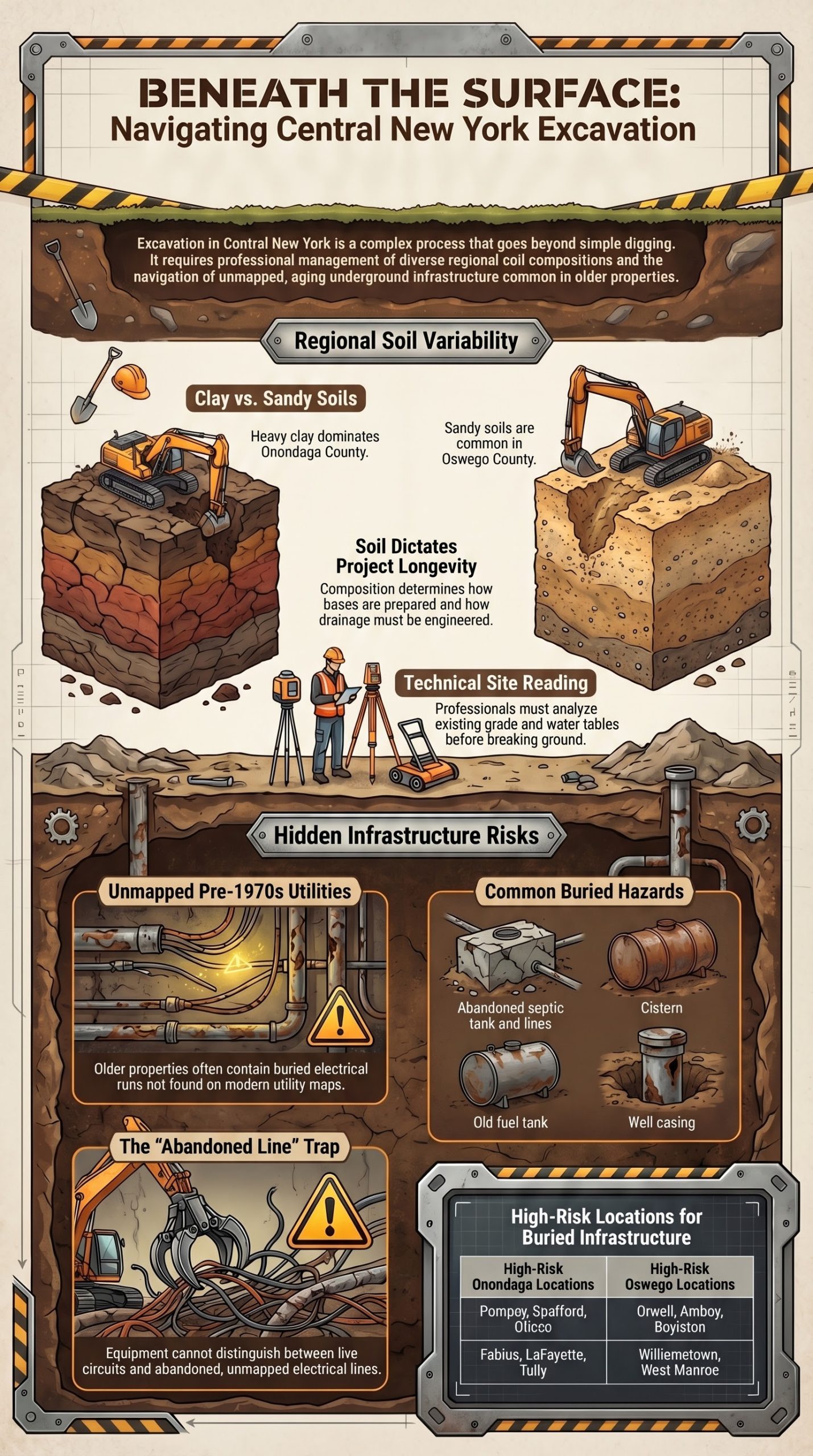
What Excavation Actually Involves
Excavation is not simply digging. It means reading the existing grade, understanding the soil composition, knowing how deep to go to reach stable base material, managing the water table where it is a factor, and planning for where the excavated material goes. In Central New York, soil conditions vary significantly across both counties. Sandy, well-draining soils are common in parts of Oswego County near former lakebed terrain. Heavy clay soils dominate much of Onondaga County, particularly in the valley communities. Knowing the difference changes how a base is prepared, how drainage is engineered, how equipment moves across the site, and how long a finished project will hold up through the seasons.
The Underground Utility Challenge in Older Properties
Here is a challenge that rarely appears in contractor marketing materials but is very real for homeowners across CNY: older properties in Onondaga and Oswego Counties frequently have buried infrastructure that is not where the utility maps say it is — or that is not on the utility maps at all.
Homes built before the 1970s may have older electrical service runs that were installed before standardized utility mapping requirements. Some of these properties have buried electrical conduit running through the yard at nonstandard depths, connecting detached garages, outbuildings, or old lighting systems that were added over decades of ownership. In many cases, these lines are no longer connected to an active circuit — but they are still in the ground. Excavation equipment does not know the difference between a live line and an abandoned one.
The same applies to old septic lines, abandoned cisterns, buried fuel oil tanks, private well casings, and corrugated metal drainage pipes installed in the 1950s and 1960s. These features are common in properties across rural and semi-rural areas of both counties — including Pompey, Spafford, Otisco, Fabius, LaFayette, Tully, Orwell, Amboy, Boylston, Williamstown, and West Monroe.
🚨 Always Call 811 Before Any Excavation in New York State
New York State requires property owners and contractors to contact 811 (Dig Safely New York) at least two business days before any excavation begins. Utility companies will mark the locations of active gas, electric, water, and telecom lines on your property. This is not optional — it applies to any ground disturbance, regardless of depth. That said, 811 only covers active, registered utilities. Old electrical lines, abandoned infrastructure, and privately installed systems will not appear in any registry. This is one of the strongest reasons to work with a local, experienced contractor who knows what to expect in specific neighborhoods and townships across CNY.
Old Electrical Lines and What You Need to Know Before Work Starts
In both Onondaga and Oswego Counties, older subdivisions and rural properties regularly turn up unexpected electrical infrastructure during excavation. The most common situations are: buried aluminum wiring used widely in the 1960s and 1970s; underground service feeds to outbuildings that were disconnected from the panel but never physically removed from the ground; and old yard lighting systems with direct-burial cable at inconsistent and undocumented depths.
When any of these are encountered during excavation, work must stop until the line is identified, traced, and either confirmed inactive or properly de-energized by a licensed electrician. There is no safe shortcut to that process. Striking an energized underground line with excavation equipment is a life-threatening event. A line that appears inactive should be treated as live until a qualified electrician confirms otherwise in writing.
Ground Force coordinates with property owners on infrastructure concerns before beginning any excavation project. We work alongside licensed electrical professionals whenever buried electrical infrastructure is identified or suspected. That coordination is standard — not an add-on — because addressing it correctly the first time is far less expensive than addressing it wrong even once.
Towns in Oswego County with a high density of older properties and rural acreage — including Richland, Sandy Creek, Hastings, Palermo, Granby, Hannibal, and Schroeppel — tend to have the highest frequency of undocumented buried infrastructure we encounter. Towns in Onondaga County with older housing stock — including the eastern portions of Salina, the village of Jordan, Elbridge, and older sections of Solvay — also carry elevated risk of unexpected below-grade infrastructure on excavation projects.
📚 Related Guides on This Topic
Chapter 7: Brush Removal and Land Clearing
Brush removal is often the first step in a property transformation and the one that produces the most immediate visual change. It is also regularly underestimated in scope — particularly on properties that have not been actively maintained for several years or have transitioned between owners with a gap in care.
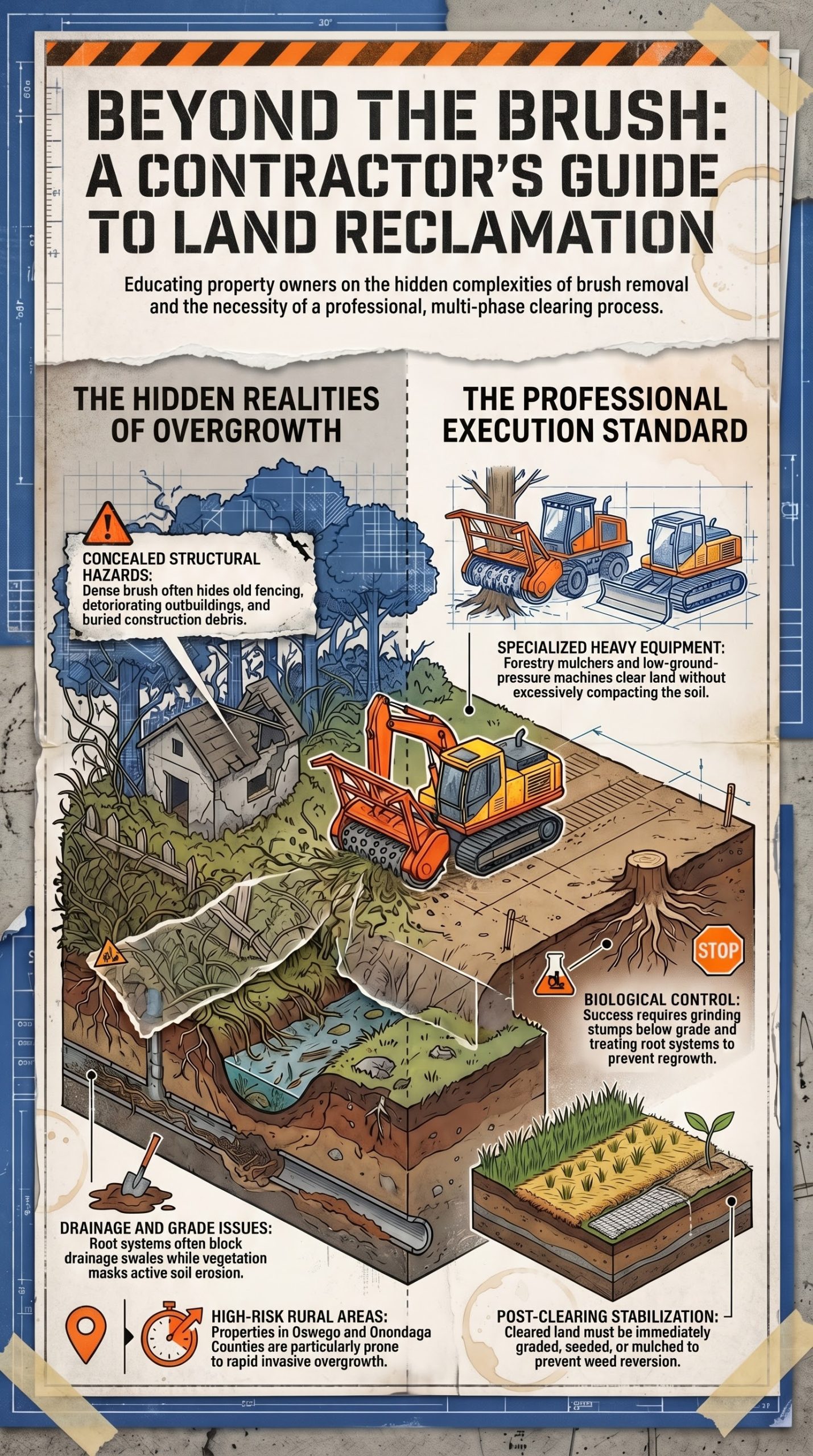
What Overgrown Properties Actually Hide
When dense brush has taken over sections of a yard, there is almost always something underneath it. Old fencing swallowed by vines. Deteriorating structures — sheds, outbuildings, retaining walls — obscured by overgrowth for years. Drainage swales or channels blocked by root systems and organic debris. Buried construction debris from prior landscaping projects that was never hauled away. And grade problems: a slope covered in dense brush and vines may be eroding actively beneath the vegetation. Remove the overgrowth and you may find a surface that requires significant stabilization before anything else can happen.
This scenario is especially common on properties in rural parts of Oswego County — Redfield, Orwell, Williamstown, Amboy, and Boylston — where wooded parcels transition directly into residential yard space and invasive species establish quickly in the absence of active management. It is also a frequent finding on Onondaga County properties that border wooded areas or that changed ownership within the past decade without a thorough property assessment.
The Process of Professional Brush Removal
Professional brush removal is not a lawn mower and determination. It involves identifying invasive species that require specific removal protocols, cutting and chipping woody material to a manageable size, grinding stumps to below grade to allow future landscaping over the area, hauling all generated debris off-site, and treating root systems of invasive species where regrowth is a real concern. Depending on the density and extent of the overgrowth, specialized equipment, such as forestry mulchers, stump grinders, and low-ground-pressure tracked machines, may be necessary to complete the work without damaging surrounding landscape features or compacting the soil excessively.
What Comes Next After the Brush Is Gone
A brush removal project done without a plan for what follows is only half a project. Once the overgrowth is cleared, the exposed soil will revert to weeds within a single growing season if left unaddressed. The options going forward include grading and seeding to establish lawn, installing landscape fabric and mulch beds, building out hardscape features on the cleared ground, or some combination of all three. Ground Force plans the post-clearing phase as part of the initial project scope whenever possible — so that cleared land does not simply become a different maintenance problem.
📚 Related Guides on This Topic
Chapter 8: Every Town in Onondaga and Oswego County — Local Challenges, Local Knowledge
Ground Force Property Services serves every municipality in both counties. The property challenges in Fayetteville are not identical to those in Pulaski. The soil in Camillus behaves differently than the soil in Sandy Creek. Local knowledge is not a marketing phrase — it is the practical difference between a project that holds up and one that gets called back in year two.
Onondaga County
Onondaga County’s property stock covers everything from dense urban neighborhoods in Syracuse to large residential and agricultural lots in Pompey and Spafford. The most common project themes vary by area.
Camillus and Van Buren regularly see drainage problems related to clay-heavy soils and flat terrain. Cicero and Clay — among the fastest-growing areas in CNY — have a large volume of mid-age homes where original landscaping and drainage systems are beginning to show their age. DeWitt, Manlius, and Fayetteville have significant concentrations of 1970s-era homes with wood decks and in-ground pools that are now strong candidates for replacement or removal.
Lysander — including the village of Baldwinsville — and Salina including the village of Liverpool, are active markets for hardscape installation as homeowners reinvest in outdoor space. Geddes and Solvay have older housing stock with a higher-than-average frequency of underground infrastructure surprises on excavation projects. Elbridge, the village of Jordan, and Marcellus are smaller communities where brush removal and drainage work on larger residential lots are common requests.
LaFayette, Tully, Otisco, Fabius, and Onondaga township serve a more rural base with larger parcel sizes and properties that often carry decades of deferred outdoor maintenance. Pompey and Spafford sit in hilly terrain where erosion control and retaining wall work are frequent needs tied to slope instability. North Syracuse, East Syracuse, and Minoa are established villages with older neighborhoods where pool removal and deck replacement projects are routine parts of our workload. Skaneateles, in the southern portion of the county, has a mix of lakefront and inland properties — many with premium outdoor living expectations and aging infrastructure beneath them.
Oswego County
Oswego County presents its own distinct set of property challenges, shaped by proximity to Lake Ontario, the region’s above-average annual snowfall, and a housing stock that in many areas dates to the mid-twentieth century or earlier.
The cities of Oswego and Fulton have dense urban neighborhoods with limited per-property outdoor space, where pool removal, drainage correction, and hardscape installations require careful coordination with neighboring properties and tight site access. Phoenix, Minetto, and Hannibal — smaller communities along the Oswego River corridor — frequently deal with drainage problems tied to proximity to the river and low-lying terrain that holds seasonal water well into spring.
Mexico, Parish, and Central Square are mid-size communities with a mix of residential and rural properties where brush removal and yard excavation are common, along with drainage work on lots that hold snowmelt into late spring. Scriba, New Haven, and Volney sit along the Lake Ontario shoreline and receive the heaviest lake-effect snowfall in the region — a direct compounding factor for freeze-thaw damage on every outdoor surface, and a strong argument for durable, properly installed hardscape over wood structures.
Pulaski, Sandy Creek, and Lacona serve a significant recreational and second-home property market, where properties may go without active maintenance for extended periods and require comprehensive clearance, grading, and infrastructure work before improvements can begin. Richland, Orwell, Amboy, and Boylston are rural townships where large parcel sizes, wooded lots, and older property infrastructure — including the buried electrical concerns covered in Chapter 6 — create the most complex project profiles we regularly encounter.
Granby, Palermo, Schroeppel, and West Monroe cover the central portion of the county with a mix of residential, rural, and light commercial properties where drainage improvement and brush management are steady needs. Williamstown, Hastings, and Albion are the northernmost communities in the county and see some of the highest annual snowfall totals in all of Central New York — making proper drainage installation and frost-resistant hardscape materials not just better choices, but necessary ones for any outdoor investment to survive long-term.
Why Local Knowledge Makes Every Difference
A contractor from outside this region will not know that the soil in Clay behaves differently than the soil in Pompey. They will not know that a property near Scriba on Lake Ontario will face weather conditions that a property in Skaneateles will not. They will not know to look for old cisterns in East Syracuse or to expect buried utility surprises in the older parts of Salina. Local experience is not a selling point — it is the practical foundation for work that actually holds up over time in this climate.
Ground Force Property Services is based in Central New York. We work in these counties because we live here. We know this land, we know these neighborhoods, and we understand what it takes to build something that survives a CNY winter and looks good doing it.
📚 More County-Specific Guides
Summary
The Property Your Central New York Home Deserves
Standing water, rotting decks, aging pools, overgrown brush, and eroded soil are not problems that fix themselves. In a climate like Central New York’s, every season that passes without addressing them adds to the eventual cost of correction.
French drains and proper grading solve drainage problems permanently. Pool removal gives you your backyard back. Concrete pavers replace a deteriorating deck with a surface that will outlast the house. Excavation prepares the ground for every improvement that follows. Brush removal reclaims land that has been lost to neglect.
Ground Force Property Services handles all of it — every town in Onondaga and Oswego County — with the equipment, local knowledge, and veteran work ethic that these projects require.
References
Common Ground Alliance. (2022). Best practices for damage prevention: Underground utility locating and excavation safety. Common Ground Alliance.
Cornell Cooperative Extension. (2021). Soil drainage and land use in New York State. Cornell University.
Dig Safely New York. (2023). Know what’s below: 811 one-call law requirements for New York State. New York State Department of Public Service. https://digsafelynewyork.com
Federal Emergency Management Agency. (2020). Reducing flood losses through the International Codes: Meeting the requirements of the National Flood Insurance Program. FEMA.
Interlocking Concrete Pavement Institute. (2021). Segmental retaining walls and interlocking concrete pavements in freeze-thaw climates: Installation guidelines. ICPI.
New York State Department of Environmental Conservation. (2022). Invasive species identification and management: Central New York region. NYSDEC.
Onondaga County Department of Planning and Environment. (2022). Onondaga County comprehensive plan: Land use and development patterns. Onondaga County.
Oswego County Planning. (2021). Oswego County comprehensive plan update: Housing, infrastructure, and environmental considerations. Oswego County.