
Table of Contents
- Chapter 1: What Site Work Actually Means and Why It Comes First
- Chapter 2: The Soil Beneath Your Feet
- Chapter 3: Grading: The Most Underestimated Step
- Chapter 4: Excavation: When and Why the Ground Needs to Come Out
- Chapter 5: Drainage Infrastructure
- Chapter 6: Clearing and Demolition
- Chapter 7: Compaction
- Chapter 8: Erosion Control and Slope Stabilization
- Chapter 9: Site Work for New Outdoor Structures
- Chapter 10: Planning, Permits, and Working With Ground Force
Chapter 1: What Site Work Actually Means and Why It Comes First
Site work is the collection of tasks that prepares a piece of ground for whatever comes next. It is grading and slope correction. It is excavation. It is soil amendment and compaction. It is drainage routing, erosion control, underground utility identification, tree stump grinding, debris clearing, and subbase preparation. It is the work that establishes whether your finished project will hold up for twenty years or start showing problems in two.
In Onondaga and Oswego Counties, we face specific conditions that make site work especially important. Heavy clay soil. Aggressive freeze and thaw cycles from November through March. Significant snowfall and spring snowmelt. Older neighborhoods with lot grading that has shifted over decades. Rural properties in Oswego County with wooded lots, uneven terrain, and drainage challenges.
Chapter 2: The Soil Beneath Your Feet
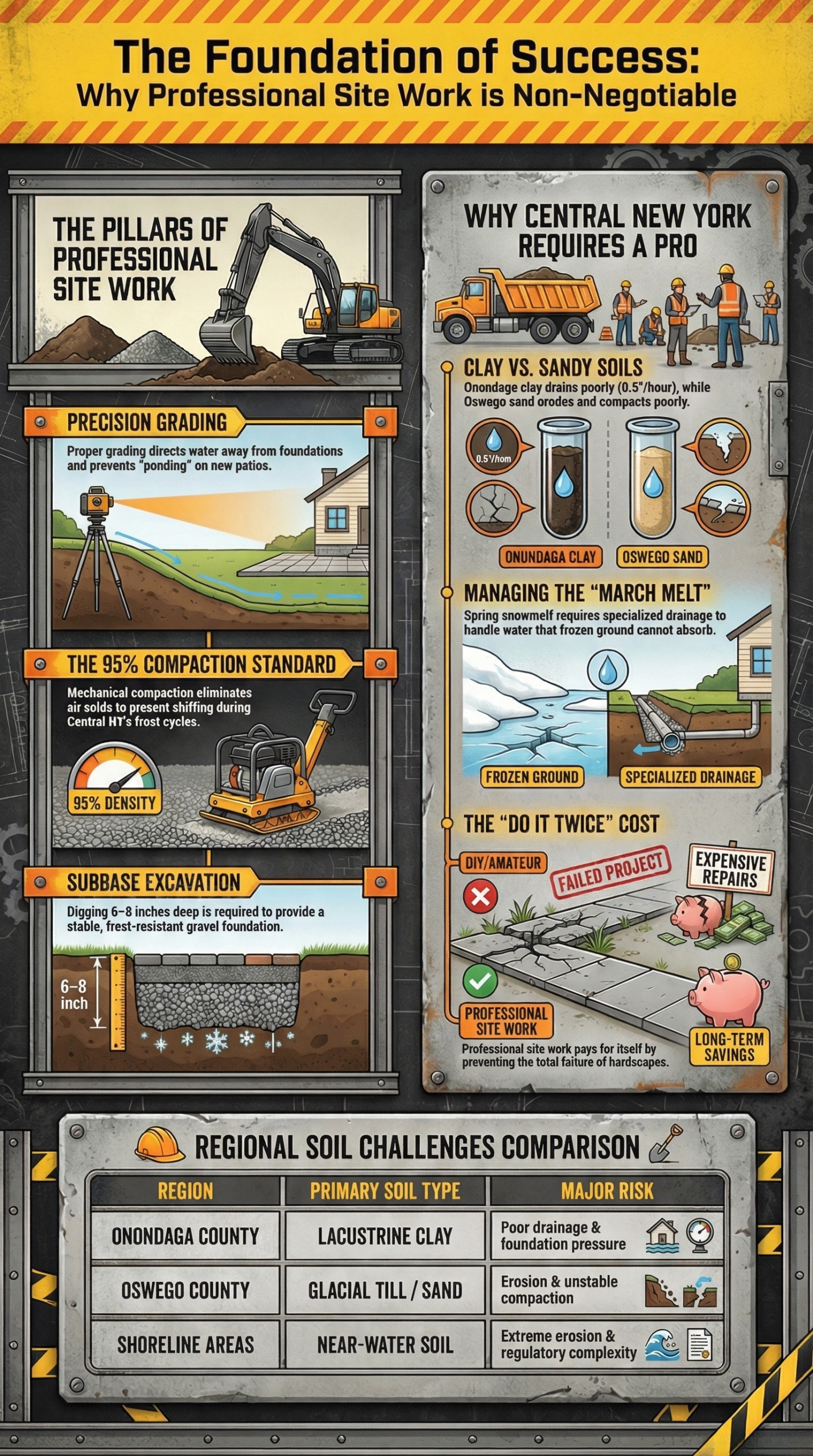
Onondaga County sits on glacially deposited soils that are heavily influenced by the last ice age. The dominant soil type is a lacustrine clay or silty clay loam that compacts easily, drains poorly, and expands and contracts with moisture changes. Clay soils have infiltration rates below 0.5 inches per hour, meaning water moves through them very slowly.
Oswego County presents a different but equally challenging soil picture. Closer to Lake Ontario, soils shift toward glacial outwash deposits with more sand and gravel content. Sandy soils erode easily, particularly on sloped lots, and do not hold compaction as well as more cohesive soils.
Chapter 3: Grading: The Most Underestimated Step
Grade controls where water goes every time it rains or snows. The International Residential Code requires a minimum six-inch drop in grade over the first ten feet away from a foundation wall. In my experience across Onondaga and Oswego Counties, a significant number of homes in older neighborhoods no longer meet this standard because soil has settled over decades.
Every hardscaped surface we install requires a specific finish grade before a single paver goes down. The surface must slope slightly away from any structure it abuts to direct surface water off the paved area. If the finish grade is wrong before the base goes in, the entire installation is built on the wrong angle.
Chapter 4: Excavation: When and Why the Ground Needs to Come Out
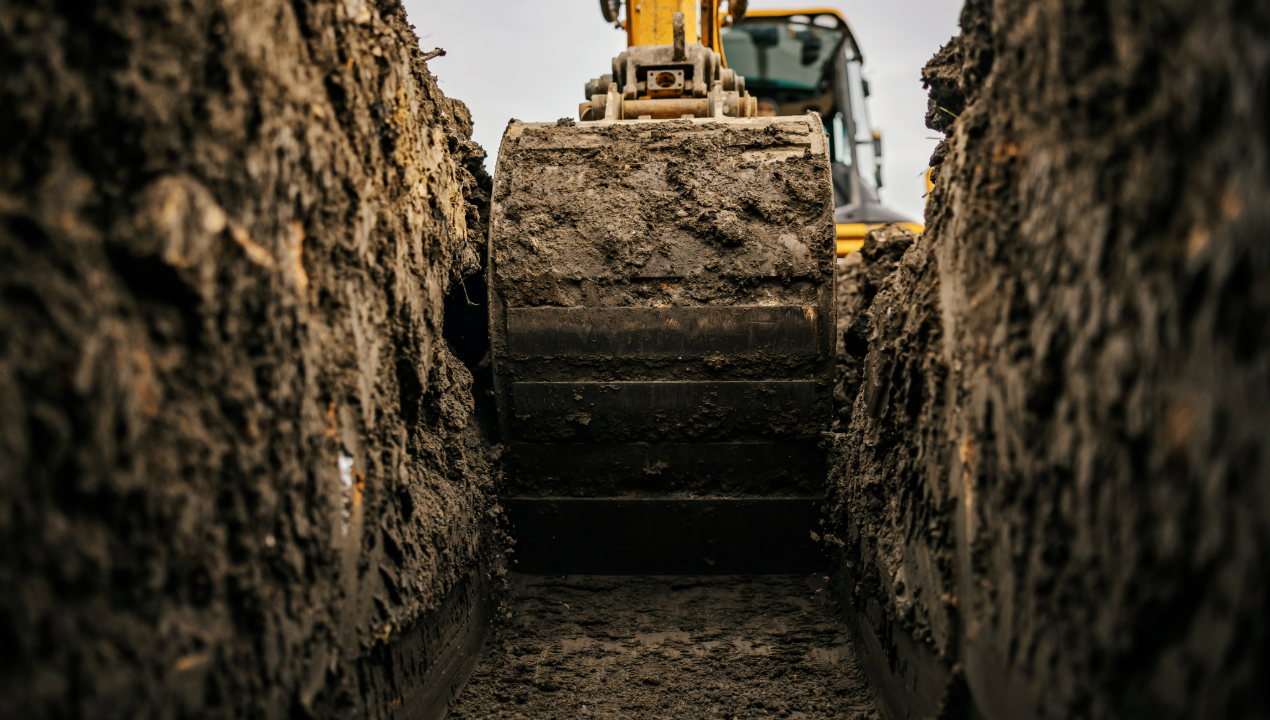
Proper paver installation requires excavating to a depth that accommodates a compacted gravel base, a sand bedding layer, and the paver thickness. For a standard residential patio in Central New York, that means excavating six to eight inches below the finished surface elevation. The frost depth in Onondaga and Oswego Counties reaches 36 to 48 inches in cold winters.
New York State law requires contacting 811 before any excavation begins. Underground utilities must be marked before digging. Beyond utility marking, we identify and document any existing drainage infrastructure on the property before excavation begins. Old clay tile agricultural drains, cracked terracotta sewer laterals, and prior underground installations from previous owners are all things we encounter regularly in both counties.
Chapter 5: Drainage Infrastructure
Water is the most persistent force acting on any outdoor installation. Proper site work addresses water movement before anything else goes in, because no surface improvement survives long on a site that has not solved its drainage problem.
Properties on hydric soils — common across much of Onondaga County’s Onondaga Lake watershed — need subsurface drainage systems that lower the local water table enough to allow root zone drying, prevent frost heave under hardscaping, and keep foundation walls from continuous contact with saturated soil.
Chapter 6: Clearing and Demolition
A significant number of properties we work on in rural Oswego County and in older residential areas of Onondaga County have sections of yard overgrown with invasive brush, brambles, volunteer trees, and dense ground cover. Multiflora rose, common buckthorn, Japanese knotweed, and Autumn olive are among the most common invasive shrubs we encounter, and they do not simply pull out.
Old concrete sidewalks, crumbling asphalt driveways, deteriorated wood decks, and abandoned outbuildings all need to be properly removed before new work begins. One of the most common shortcuts we see is installing over existing concrete rather than removing it — which causes every movement and irregularity of the old slab to transfer upward.
Chapter 7: Compaction
Compaction is the mechanical process of densifying soil or aggregate base material by eliminating air voids. We compact backfill in lifts — adding and compacting material in layers of six to twelve inches rather than filling the entire void and compacting once at the top. Single pass compaction on deep fills leaves lower layers loose regardless of how much force is applied at the surface.
Chapter 8: Erosion Control and Slope Stabilization
Slopes steeper than approximately three to one generally cannot be stabilized by turf alone. In Central New York’s climate, slopes above this ratio require engineering: retaining walls, terracing, erosion control blankets, or riprap where water concentrates.
Properties in Oswego County near Lake Ontario, the Oswego River, or county lake frontages face erosion conditions that go beyond a typical residential yard. Wave action, shoreline slumping, and the freeze and thaw cycles specific to near-water environments require site work approaches guided by NYSDEC shoreline guidelines.
Chapter 9: Site Work for New Outdoor Structures
Every outdoor structure a homeowner builds sits on the ground, and the condition of the ground beneath it determines how that structure performs over its life. Retaining walls in Central New York have a high failure rate when DIY or under-engineered, due to clay soils that retain water and create high lateral pressure combined with freeze-thaw cycles that apply repetitive stress to wall bases.
Chapter 10: Planning, Permits, and Working With Ground Force
We are based in the heart of Central New York and we work exclusively in Onondaga and Oswego Counties. We know these soils. We know the freeze-thaw conditions here. We know the drainage challenges in the Onondaga Lake watershed. We know what a March snowmelt does to a poorly graded yard.
Our estimates are free and we come to the property. We do not price site work based on a photo or a phone call because site conditions determine the scope of work.
Give Ground Force Property Services, LLC a call at 315-461-7747, or schedule your free consultation.
References
American Society of Civil Engineers. (2017). ASCE 38-02: Standard guideline for the collection and depiction of existing subsurface utility data. ASCE.
Central New York Regional Planning and Development Board. (2018). Onondaga Lake watershed management plan. CNY RPDB.
International Code Council. (2021). International residential code for one and two-family dwellings. ICC.
New York State Department of Environmental Conservation. (2022). Tidal and freshwater wetlands regulations. NYSDEC.
New York State Department of Environmental Conservation. (2023). Invasive species factsheet: Japanese knotweed. NYSDEC.
Onondaga County Department of Water Environment Protection. (2020). Save the Rain program annual report. Onondaga County.
📖 Complete Property Transformation Guide
This article is part of Ground Force’s complete guide for Onondaga and Oswego County homeowners — covering yard warning signs, drainage, pool removal, hardscape installation, excavation, buried utilities, and brush clearing.