
Table of Contents
- Chapter 1: What Site Work Actually Means and Why It Comes First
- Chapter 2: The Soil Beneath Your Feet: Understanding What We Are Working With
- Chapter 3: Grading: The Most Underestimated Step in Any Outdoor Project
- Chapter 4: Excavation: When and Why the Ground Needs to Come Out
- Chapter 5: Drainage Infrastructure: Building Water Out of the Equation
- Chapter 6: Clearing and Demolition: Making Space Before Making Progress
- Chapter 7: Compaction: The Step That Holds Everything Together
- Chapter 8: Erosion Control and Slope Stabilization
- Chapter 9: Site Work for New Outdoor Structures
- Chapter 10: Planning, Permits, and Working With Ground Force
CHAPTER ONE
What Site Work Actually Means and Why It Comes First
When most homeowners think about improving their outdoor space, they think about the finished product. The patio. The retaining wall. The new lawn. The fire pit. What they rarely think about is everything that has to happen before any of that is possible, and that oversight is the single most common reason outdoor projects fail within a few years of completion.
Site work is the collection of tasks that prepares a piece of ground for whatever comes next. It is grading and slope correction. It is excavation. It is soil amendment and compaction. It is drainage routing, erosion control, underground utility identification, tree stump grinding, debris clearing, and subbase preparation. It is the work that establishes whether your finished project will hold up for twenty years or start showing problems in two.
I want to be direct about something: site work is not glamorous. It does not photograph well. A homeowner watching an excavator reshape their yard for three days is not looking at anything that looks like progress until the final result comes together. But in my experience, the homeowners who understand what site work is and why it matters end up with outdoor spaces they are proud of for a long time. The ones who skip it or cut corners come back to us for repair work.
In Onondaga and Oswego Counties, we face specific conditions that make site work especially important. Heavy clay soil. Aggressive freeze and thaw cycles from November through March. Significant snowfall and spring snowmelt that can move large volumes of water across a property in a short time. Older neighborhoods with lot grading that has shifted over decades. Rural properties in Oswego County with wooded lots, uneven terrain, and drainage challenges that urban contractors have never encountered.
This article walks through every major reason professional site work is not optional if you want an outdoor project done right in this part of New York State.
CHAPTER TWO
The Soil Beneath Your Feet: Understanding What We Are Working With
Clay Soils in Onondaga County
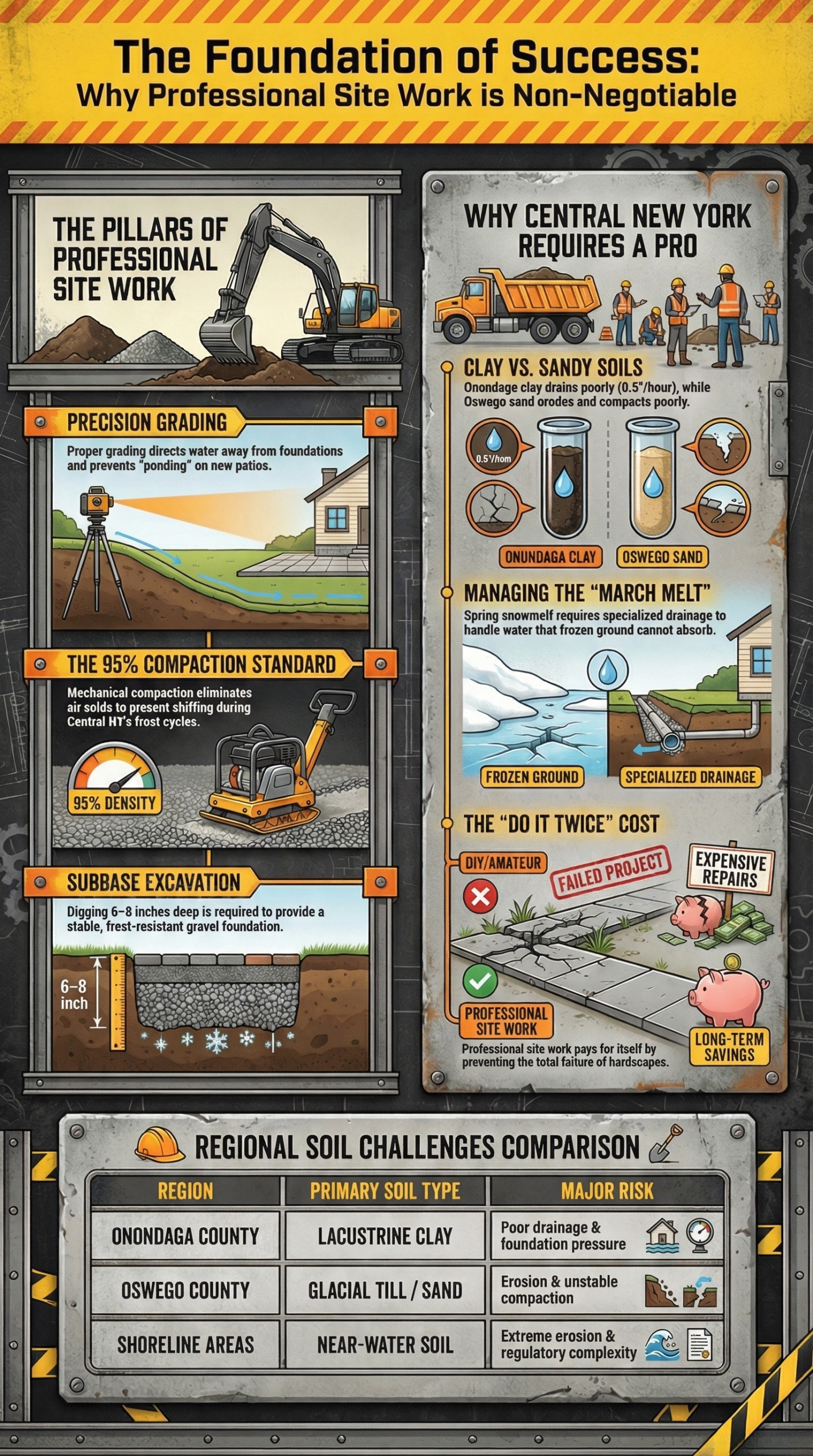
Onondaga County sits on glacially deposited soils that are heavily influenced by the last ice age. The dominant soil type across much of the county is a lacustrine clay or silty clay loam that compacts easily, drains poorly, and expands and contracts with moisture changes. The Cornell Soil Health Assessment framework describes clay soils of this type as having infiltration rates below 0.5 inches per hour, meaning water moves through them very slowly compared to sandy or loamy soils (Moebius-Clune et al., 2016).
What this means practically is that when it rains on a clay yard, the water has nowhere to go quickly. It sits on the surface. It runs off to the lowest point, which is often a foundation wall or a low spot in the yard that collects standing water after every storm. It saturates the top layer of soil, making it unstable and unable to support weight. Any outdoor project built on clay soil that has not been properly prepared, graded, and, in many cases, amended is built on an unpredictable foundation.
Oswego County: Glacial Till and Sandy Soils
Oswego County presents a different but equally challenging soil picture. Closer to Lake Ontario, soils shift toward glacial outwash deposits with more sand and gravel content. These drain more freely than the clay soils to the south, but they bring their own set of challenges. Sandy soils erode easily, particularly on sloped lots. They do not hold compaction as well as more cohesive soils. On properties near the lake shore, soil salt content and the influence of prevailing west winds create conditions that degrade organic matter quickly and require more aggressive soil preparation before establishing vegetation (New York State Department of Environmental Conservation, 2021).
Rural properties in Oswego County also frequently sit on lots that have not been formally graded, have significant tree canopy that creates root systems interfering with excavation, and may have existing structures like old field drainage tile systems dating back to the agricultural use of the land that must be located and addressed before any new work begins.
Why Soil Assessment Comes First
Before we begin any site work project, we assess the soil conditions on the property. This is not a complicated laboratory process for most residential jobs. It is a trained eye looking at how the ground responds to probing, how water moves across the surface after rainfall, what the existing compaction looks like, and whether there are any visible signs of prior drainage, fill placement, or structural disturbance.
That assessment shapes every decision we make. Soil that is heavily compacted needs mechanical loosening before we can establish a stable grade. Soil with a hardpan layer a few inches below the surface requires deeper work to allow drainage to function. Soil that has been previously filled needs to be evaluated for how well that fill was placed and whether it is providing stable support. Getting this right at the beginning prevents every major failure mode we see in outdoor projects.
CHAPTER THREE
Grading: The Most Underestimated Step in Any Outdoor Project
Grade is the slope of the ground surface. It controls where water goes every time it rains or snows. It determines whether water runs toward or away from your house. It sets whether your patio holds puddles or drains cleanly. It governs whether your retaining wall is under normal soil pressure or fighting a saturated hillside every spring. Grading is, in my view, the single most important step in site work, and it is the one most frequently done poorly.
Foundation Protection Grading
The International Residential Code requires a minimum six inch drop in grade over the first ten feet away from a foundation wall. This standard exists because positive drainage away from the foundation is the most reliable way to prevent basement moisture intrusion, foundation wall cracking, and frost heave at the footing level (International Code Council, 2021). In my experience across Onondaga and Oswego Counties, a significant number of homes in older neighborhoods no longer meet this standard because soil has settled over decades, mulch and garden beds have built up against the foundation, and grading work done during construction has shifted.
Restoring proper foundation grading is often one of the first things we do when a homeowner reports basement moisture problems. It is not always the complete solution, but it is almost always part of one. I have walked properties where regrading the yard and extending downspout discharge lines resolved a basement moisture problem that the homeowner had been fighting with interior waterproofing systems for years, spending thousands of dollars on a symptom rather than the source.
Grading for Hardscape Installation
Every hardscaped surface we install, from a backyard patio to a pool deck to a front entry walkway, requires a specific finish grade before a single paver goes down. The surface must slope slightly away from any structure it abuts, typically one eighth of an inch per foot, to direct surface water off the paved area rather than toward the house or toward a low spot where it will pond.
If the finish grade is wrong before the base goes in, the entire installation is built on the wrong angle. Once pavers are set and compacted, adjusting the grade underneath means tearing the whole project out. I have seen contractor work where the patio actually pitched water back toward the house because the installer either skipped grade verification or did not understand how the base settles over time. Catching that in the site work phase costs nothing extra. Fixing it after the fact costs the full project price.
Grading for Lawn and Seed Establishment
Establishing a new lawn over improperly graded soil is one of the most common sources of frustration I hear from homeowners who have tried to seed or sod a yard themselves. Low spots collect water and stay saturated long enough to drown new grass roots. High spots dry out faster than anything around them and go brown. Ruts from equipment or foot traffic during soft conditions create channels that concentrate runoff and prevent even seed germination.
Professional finish grading before seeding is not about making the yard look flat. It is about creating a consistently draining surface that holds moisture evenly, provides seed with the contact it needs with prepared soil, and prevents channeling and puddling that kill new grass before it establishes. The United States Department of Agriculture Natural Resources Conservation Service documents the direct relationship between surface drainage and successful vegetation establishment, noting that even minor surface irregularities of two inches or more in low spots can prevent successful turf establishment in humid continental climates like Central New York (USDA NRCS, 2019).
Grade is not cosmetic. It is the single variable that determines whether water works for your property or against it.
CHAPTER FOUR
Excavation: When and Why the Ground Needs to Come Out
Excavation is the process of removing soil, rock, or existing material from a site to a specified depth and geometry. It is required for virtually every meaningful outdoor project, and the precision with which it is done directly affects the performance of everything installed above it.
Excavation for Hardscape Bases
Installing concrete pavers on an unprepared surface is not installation. It is placing paving stones on dirt, which will shift, settle unevenly, and fail within a few seasons. Proper paver installation requires excavating to a depth that accommodates a compacted gravel base, a sand bedding layer, and the paver thickness itself. For a standard residential patio in Central New York, that means excavating six to eight inches below the finished surface elevation.
The depth is not arbitrary. It is determined by the frost depth for the region, which in Onondaga and Oswego Counties reaches 36 to 48 inches in cold winters, and by the need to provide enough compacted base material so that freeze-thaw movement at the surface does not translate directly into paver displacement. Getting the excavation depth right is not something you can eyeball. It requires measurement, calculation, and a base material specification matched to the soil conditions and expected load.
Excavation for Drainage Systems
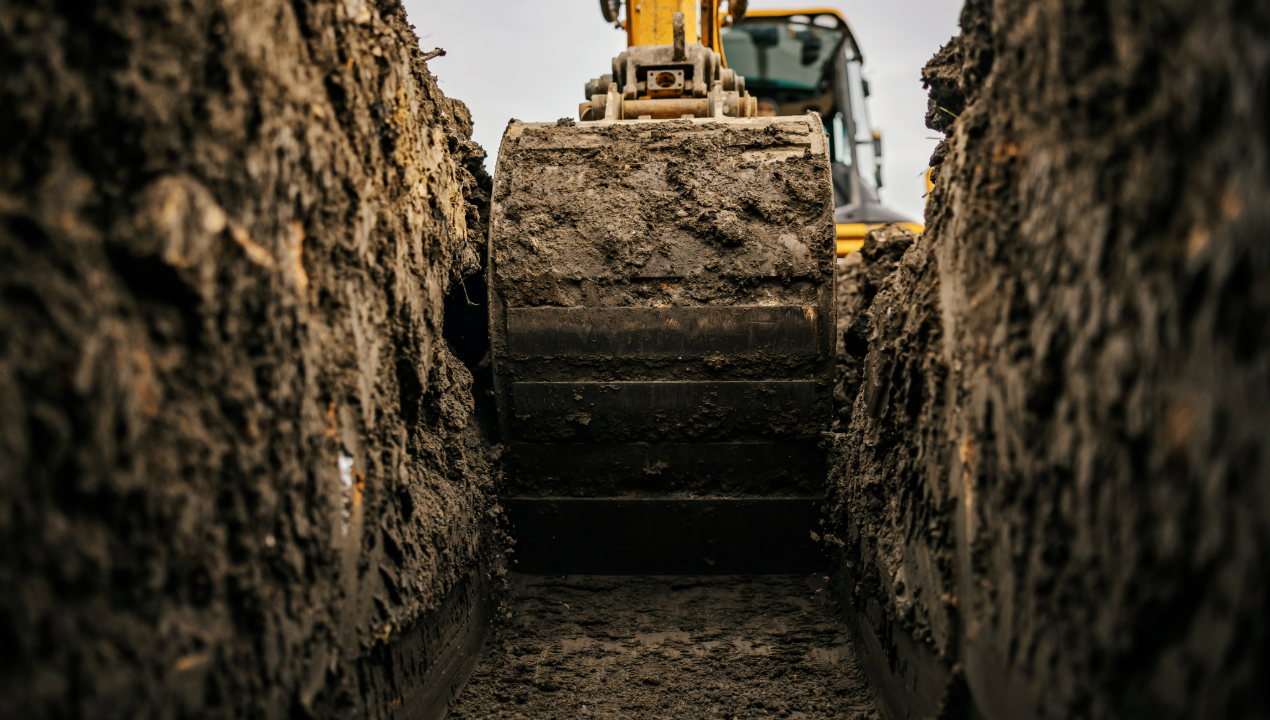
Installing a French drain, a perimeter drain, or any below-grade drainage system requires trenching to the depth where the pipe will intercept groundwater or surface runoff effectively. The trench must be dug to grade, meaning it must slope continuously toward the discharge point at a minimum of one percent fall, which is about one inch for every eight feet of run.
Trenching that is done by hand or with imprecise equipment frequently produces uneven trench bottoms that create low spots where water can pond inside the pipe system rather than flowing to the outlet. We use laser levels and grade stakes to verify trench bottom elevation at multiple points before any pipe goes in. A drainage system with a level trench bottom that has one or two low spots will back up and fail. The homeowner will not know it failed until basement moisture returns or yard flooding resumes.
Excavation for Retaining Walls
Retaining walls hold back soil. They are under continuous lateral pressure from the material behind them, and that pressure increases dramatically when the retained soil is saturated. Proper retaining wall installation begins with excavation that removes all unstable or organic material from the base course foundation, establishes a level bearing surface for the first course of block or stone, and creates space behind the wall for a drainage aggregate backfill that relieves hydrostatic pressure.
Retaining walls that fail almost always fail because the base was not properly excavated and compacted, because the drainage aggregate behind the wall was insufficient, or because the wall was not engineered for the height and soil loading it was actually under. In New York State, retaining walls over four feet in exposed height typically require engineered drawings and a permit. We work within those requirements and do not build walls that exceed safe limits without proper engineering support.
Excavation Near Utilities and Existing Infrastructure
New York State law requires that property owners and contractors contact 811, the statewide one call center, before any excavation begins. Underground utilities including gas, electric, water, sewer, telecommunications, and cable must be marked before digging. Violating this requirement is not only illegal but can result in service disruptions, utility damage costs, and in the case of gas lines, serious physical danger.
Beyond utility marking, we identify and document any existing drainage infrastructure on the property before excavation begins. Old clay tile agricultural drains, cracked terracotta sewer laterals, and prior underground installations from previous owners are all things we encounter regularly on properties in Onondaga and Oswego Counties. Excavating through an unknown drain tile without a plan for how to address it creates a drainage problem that did not exist before the job started.
CHAPTER FIVE
Drainage Infrastructure: Building Water Out of the Equation
Water is the most persistent force acting on any outdoor installation. It finds every low spot. It exploits every crack. It saturates soil until that soil loses its ability to support anything above it. Proper site work addresses water movement before anything else goes in, because no surface improvement survives long on a site that has not solved its drainage problem.
Surface Drainage and Sheet Flow Management
Sheet flow is the movement of water across a surface as a thin, distributed layer before it concentrates into channels. Managing sheet flow is about ensuring that surfaces are graded consistently to move water toward intended collection or dispersal points rather than allowing it to pool, concentrate in unwanted locations, or flow toward structures.
On residential properties in Onondaga County, sheet flow problems are especially common in spring when frozen ground cannot absorb snowmelt and all surface water moves as runoff. A yard that manages rainfall adequately in summer can become a saturated, channeled mess in March and April when the ground is still frozen below the surface. Site work that accounts for this seasonal condition addresses grading with that spring condition in mind, not just the average summer rain event.
Subsurface Drainage and Groundwater Management
Many properties in both Onondaga and Oswego Counties have seasonally high water tables that create wet conditions even on days with no rainfall. The Regional Planning Association of Central New York documents that the Onondaga Lake watershed, which includes much of the urbanized portion of Onondaga County including Liverpool, has significant areas of hydric soils associated with historically poor drainage and high seasonal groundwater (Central New York Regional Planning and Development Board, 2018).
Properties on hydric soils need subsurface drainage systems that lower the local water table enough to allow root zone drying for turf, prevent frost heave under hardscaping, and keep foundation walls from being in continuous contact with saturated soil. French drains, curtain drains, and perimeter drainage systems serve this function. They are not installed in response to a single wet event but are designed to manage the chronic groundwater condition that defines those soils across seasons.
Stormwater Management and Local Compliance
Onondaga County has invested significantly in combined sewer overflow reduction and stormwater management as part of the Save the Rain program, a consent order driven infrastructure improvement effort that directly affects how residential development and site work must manage stormwater (Onondaga County Department of Water Environment Protection, 2020). Projects that increase impervious surface area may be subject to stormwater management requirements, and site work that moves drainage discharge to new locations must consider where that water goes and whether it complies with local ordinances.
We understand these requirements and help homeowners navigate what applies to their project. Most residential site work and hardscaping in Liverpool and surrounding communities does not trigger formal stormwater management review, but larger projects involving significant new impervious area or major grading changes on properties near waterways require more careful planning.
CHAPTER SIX
Clearing and Demolition: Making Space Before Making Progress
Brush Clearing and Overgrown Lot Reclamation
A significant number of properties we work on in rural Oswego County and in older residential areas of Onondaga County have sections of yard that have been allowed to overgrow with invasive brush, brambles, volunteer trees, and dense ground cover. Multiflora rose, common buckthorn, Japanese knotweed, and Autumn olive are among the most common invasive shrubs we encounter, and they do not simply pull out. Their root systems are extensive, their regrowth is aggressive, and cutting them back without removing the root system produces more vigorous regrowth within a single season.
Professional brush clearing involves mechanical removal of above ground material, grinding or excavation of root systems where practical, and in many cases multiple site visits to address regrowth. The New York State Department of Environmental Conservation identifies Japanese knotweed in particular as one of the most difficult invasive plants to eradicate because its rhizome system can extend ten feet laterally and six feet deep, and any fragment left in the soil can regenerate (NYSDEC, 2023). Homeowners who attempt to clear knotweed infestations with a brush cutter alone typically accelerate its spread.
Tree and Stump Removal
Trees that need to come down before a project can proceed require more than a chainsaw. The stump and root system beneath a removed tree create a void as they decay, and a patio, lawn, or retaining wall installed over a decaying stump will settle unevenly as that material breaks down. Stump grinding to below the installation depth, followed by removal of the grindings and replacement with compacted fill, is the correct approach before any surface installation over a former tree location.
On properties with large old trees near the work area, we also consider the influence of surface roots on grading and installation. Cutting surface roots during excavation without proper assessment can destabilize remaining trees. We work with tree locations thoughtfully rather than treating them as obstacles to be removed without consideration.
Demolition of Existing Structures and Surfaces
Old concrete sidewalks, crumbling asphalt driveways, deteriorated wood decks, and abandoned outbuildings all need to be properly removed before new work begins. Demolition is not just breaking material up. It involves removing the material and its substrate completely, assessing what lies beneath, and preparing the surface appropriately for the new installation.
One of the most common shortcuts we see in contractor work is installing over existing concrete rather than removing it. New pavers installed on top of a cracked, heaved concrete slab inherit every movement and irregularity of the slab beneath them. The additional height may also create drainage conflicts at doorways and transitions, creating new problems. Proper demolition and substrate preparation add cost upfront and eliminate far larger problems downstream.
CHAPTER SEVEN
Compaction: The Step That Holds Everything Together
Compaction is the mechanical process of densifying soil or aggregate base material by eliminating air voids. It is the step that transforms loose fill or prepared subgrade into a stable platform capable of supporting the loads and resisting the movement that outdoor surfaces experience over time. It is also the step most frequently done inadequately on residential projects.
Why Compaction Matters in Freeze and Thaw Climates
Freeze and thaw cycles are the primary stress mechanism for outdoor surfaces in Central New York. When water in soil freezes, it expands approximately nine percent by volume. In loose, poorly compacted soil with high water content, this expansion translates directly into surface movement. Pavers heave. Concrete cracks. Retaining wall base courses shift. Lawn areas develop frost boils and uneven bumps.
Properly compacted base material under hardscaping holds less water because the voids between aggregate particles are smaller. Less water means less expansion during freezing, which means less movement at the surface. The American Society of Civil Engineers publishes standards for base compaction under paved surfaces that call for a minimum 95 percent of maximum dry density as determined by proctor testing for base materials under pedestrian hardscaping (ASCE, 2017). Residential contractors rarely perform proctor testing, but experienced site work professionals achieve equivalent results by selecting the appropriate base aggregate, specifying the correct lift thickness, and using the right compaction equipment for the material and depth.
Compaction for Backfill Applications
Whenever we excavate and then replace material, whether for a drainage trench, a pool removal backfill, a utility installation, or a graded area, the replacement material must be compacted properly or it will settle over time. Settlement in backfill produces surface depressions, cracked pavers, and drainage flow reversals in pipes that were installed to grade.
We compact backfill in lifts, meaning we add and compact material in layers of six to twelve inches rather than filling the entire void and compacting once at the top. Single pass compaction on deep fills leaves lower layers loose regardless of how much force is applied at the surface. The compaction equipment does not reach that deep. Lift compaction takes more time and discipline on a job site, but it is the only way to achieve consistent density through the full depth of a backfill.
CHAPTER EIGHT
Erosion Control and Slope Stabilization
Erosion is the movement of soil by water or wind. On residential properties in Onondaga and Oswego Counties, water erosion is the primary concern, and it is a problem that site work must address both during construction and in the finished installation.
Construction Phase Erosion Control
During site work, disturbed soil is exposed and vulnerable. A single heavy rain event on a freshly graded yard can move significant amounts of topsoil to the lowest point, undo grading work, and deposit sediment in drainage systems, neighboring properties, and waterways. New York State requires erosion and sediment control measures on construction sites, and the principles apply to residential site work even on projects below the formal permit threshold.
We use silt fence, straw wattles, and temporary seeding on exposed slopes during and immediately following site work to prevent erosion while permanent vegetation or hardscaping is being established. These are not cosmetic measures. They protect the grading work we have done from being undone by the first storm after we leave.
Slope Stabilization on Finished Projects
Slopes that are steeper than approximately three to one, meaning three feet of horizontal run for every one foot of vertical rise, generally cannot be stabilized by turf alone. In Central New York’s climate, with its heavy spring runoff and summer thunderstorm events, slopes above this ratio require engineering: retaining walls, terracing, erosion control blankets with deep-rooted vegetation, or riprap where water concentrates.
We assess every sloped area on a project site and make honest recommendations about what stabilization method is appropriate. Seeding a steep slope with grass and hoping for the best is not a plan. It is a delay before an erosion problem that will need to be addressed at higher cost after the slope has already failed.
Oswego County Shoreline and Near-Water Properties
Properties in Oswego County near Lake Ontario, the Oswego River, or any of the county’s numerous lake frontages face erosion conditions that go well beyond a typical residential yard. Wave action, shoreline slumping, and the freeze and thaw cycles specific to near-water environments require site work approaches guided by the New York State Department of Environmental Conservation’s shoreline guidelines and, in some cases, Army Corps of Engineers permits for work below the ordinary high water mark (NYSDEC, 2022).
I am direct with lakefront property owners in Oswego County: erosion near a waterway is not a do-it-yourself site work project. The regulatory requirements are real, the physical forces involved are larger than what standard residential site work addresses, and a poorly designed shoreline stabilization project can accelerate erosion rather than stopping it. We work with the appropriate consultants and permits on near-water projects rather than treating them like an inland yard job.
CHAPTER NINE
Site Work for New Outdoor Structures
Every outdoor structure a homeowner builds sits on the ground, and the condition of the ground beneath it determines how that structure performs over its life. Site work for outdoor structures is not optional preparation. It is the engineering foundation of the project.
Patios and Hardscaped Outdoor Living Areas
I covered base excavation and compaction earlier, but I want to address the full scope of site work involved in a patio installation because it goes beyond digging a hole and filling it with gravel. Before any base material goes in, we verify setbacks from property lines and structures, confirm there are no utility conflicts, establish the finished elevation relative to all adjacent structures and drainage features, and check that the site, as graded, will drain correctly when the patio is in place.
A patio that drains correctly on the day it is installed but creates a pooling problem at a neighbor’s property line, or that sits at an elevation that conflicts with a doorway threshold or a garage apron, is a project that was not properly planned at the site work stage. These problems are invisible in a material sample or a design rendering. They only become visible when the ground is being worked, which is exactly when they need to be caught.
Retaining Walls and Tiered Terraces
Retaining walls in both Onondaga and Oswego Counties are frequently used to address sloped lots, elevation changes at property lines, and the desire to create level, usable areas in yards that would otherwise be unusable. The site work for a retaining wall involves everything from base trench excavation and compaction to geogrid installation for taller walls to properly placed drainage aggregate behind the wall to prevent hydrostatic pressure buildup.
The failure rate of DIY and under-engineered retaining walls in Central New York is high due to the demanding soil conditions. Clay soils retain water and create high lateral pressure. Freeze and thaw cycles apply repetitive stress to wall bases and drainage systems. A wall that survives its first two winters and then fails in year three was probably always undersized for the conditions, and the failure often comes suddenly rather than gradually.
Driveways and Vehicle Traffic Areas
Site work for driveways involves deeper excavation and heavier base compaction than pedestrian surfaces because of the concentrated loading from vehicles. A residential driveway in Onondaga County sees vehicles that weigh anywhere from 3,000 pounds for a passenger car to 10,000 pounds or more for a pickup truck or delivery vehicle. The subgrade and base must be engineered for those loads over the freeze and thaw cycles of a Central New York winter.
Driveway base failures, where the surface remains intact but begins to show ruts, cracking, and surface distortion, are almost always subgrade or base failures rather than surface material failures. The asphalt or pavers on top are performing as designed. The ground underneath them is not. Correcting a base failure in a driveway means removing and replacing the entire surface, which is far more expensive than doing the base right the first time.
CHAPTER TEN
Planning, Permits, and Working With Ground Force
The Planning Process Before Any Work Begins
I want to describe how we actually approach a site work project from the first conversation, because the planning process is itself part of the service and it is where a lot of the value is delivered.
When I walk a property for the first time, I am looking at the whole picture. Where is water coming from and where is it going? What is the soil like? What is the existing grade? What structures or trees need to be worked around? What is the homeowner trying to accomplish, and what does the site actually need in order to make that happen reliably? I ask a lot of questions and I look at things most homeowners have not thought to look at.
From that assessment, we build a site work plan that sequences work correctly. Drainage before hardscaping. Grading before seeding. Demolition before base preparation. Compaction verification before surface installation. The sequence matters because work done out of order creates conflicts and rework that cost everyone time and money.
Permits and Regulatory Requirements in Onondaga and Oswego Counties
Permit requirements for site work and landscaping in this region vary by municipality, project scope, and the type of work being done. Within the Town of Liverpool and the Village of Liverpool, site grading that moves more than a specified volume of earth, installation of retaining walls above four feet, and work near wetlands or waterways may require permits from the local building department, the Onondaga County Department of Water Environment Protection, or the New York State Department of Environmental Conservation.
We navigate the permit process for every project that requires it. We do not advise homeowners to proceed without required permits, because unpermitted work creates problems at property sale, can require removal and correction at the homeowner’s expense, and in some cases creates liability exposure if the work affects neighboring properties or public infrastructure.
Why Professional Site Work Pays for Itself
The cost of professional site work is real and I do not pretend otherwise. Proper site preparation for a backyard patio adds cost compared to simply dropping gravel and paving stones on whatever is already there. Drainage installation costs money. Grading costs money. Compaction costs money.
What those costs buy is a project that performs as expected for ten, twenty, or thirty years without needing to be torn out and rebuilt. I have done the math with homeowners on more than a few occasions, comparing the upfront cost of proper site work against the cost of repair or replacement work on a project that failed in year three or four. The numbers are not close. Professional site work is almost always the less expensive path over the life of the project.
The most expensive site work is the kind you have to do twice because it was not done right the first time.
What to Expect When You Work With Ground Force
We are based in the heart of Central New York and we work exclusively in Onondaga and Oswego Counties. That is not a limitation. It is a focus. We know these soils. We know the freeze-thaw conditions here. We know the drainage challenges in the Onondaga Lake watershed. We know what a March snowmelt does to a poorly graded yard. We do not bring a standardized regional approach to this specific place and hope it works. We bring specific knowledge of the conditions here and we build that knowledge into every project.
Our estimates are free and we come to the property. We do not price site work based on a photo or a phone call because site conditions determine the scope of work, and those conditions require a visit. We provide written proposals with a clear scope and answer questions honestly, including those about what the project does not need, so a homeowner does not pay for work their site does not require.
Give Ground Force Property Services, LLC a call at 315-461-7747, or schedule your free consultation.
References
The following sources informed the technical content of this article and are provided for readers who wish to explore the underlying research and regulatory standards further.
American Society of Civil Engineers. (2017). ASCE 38-02: Standard guideline for the collection and depiction of existing subsurface utility data. American Society of Civil Engineers.
Central New York Regional Planning and Development Board. (2018). Onondaga Lake watershed management plan: Hydric soils and surface drainage assessment. CNY RPDB.
International Code Council. (2021). International residential code for one and two-family dwellings (2021 ed.). International Code Council. Section R401.3.
Moebius-Clune, B. N., Moebius-Clune, D. J., Gugino, B. K., Idowu, O. J., Schindelbeck, R. R., Ristow, A. J., van Es, H. M., Thies, J. E., Shayler, H. A., McBride, M. B., Kurtz, K. S. M., Wolfe, D. W., and Abawi, G. S. (2016). Comprehensive assessment of soil health: The Cornell framework (3.2 ed.). Cornell University.
New York State Department of Environmental Conservation. (2021). Stormwater management design manual for New York State. NYSDEC Division of Water.
New York State Department of Environmental Conservation. (2022). Tidal and freshwater wetlands regulations: Guidance for activities in or adjacent to regulated areas. NYSDEC.
New York State Department of Environmental Conservation. (2023). Invasive species factsheet: Japanese knotweed (Reynoutria japonica). NYSDEC Bureau of Invasive Species Management.
Onondaga County Department of Water Environment Protection. (2020). Save the Rain program annual report: Combined sewer overflow reduction and green infrastructure implementation. Onondaga County.
United States Department of Agriculture Natural Resources Conservation Service. (2019). Urban soil primer (2nd ed.). USDA NRCS.