
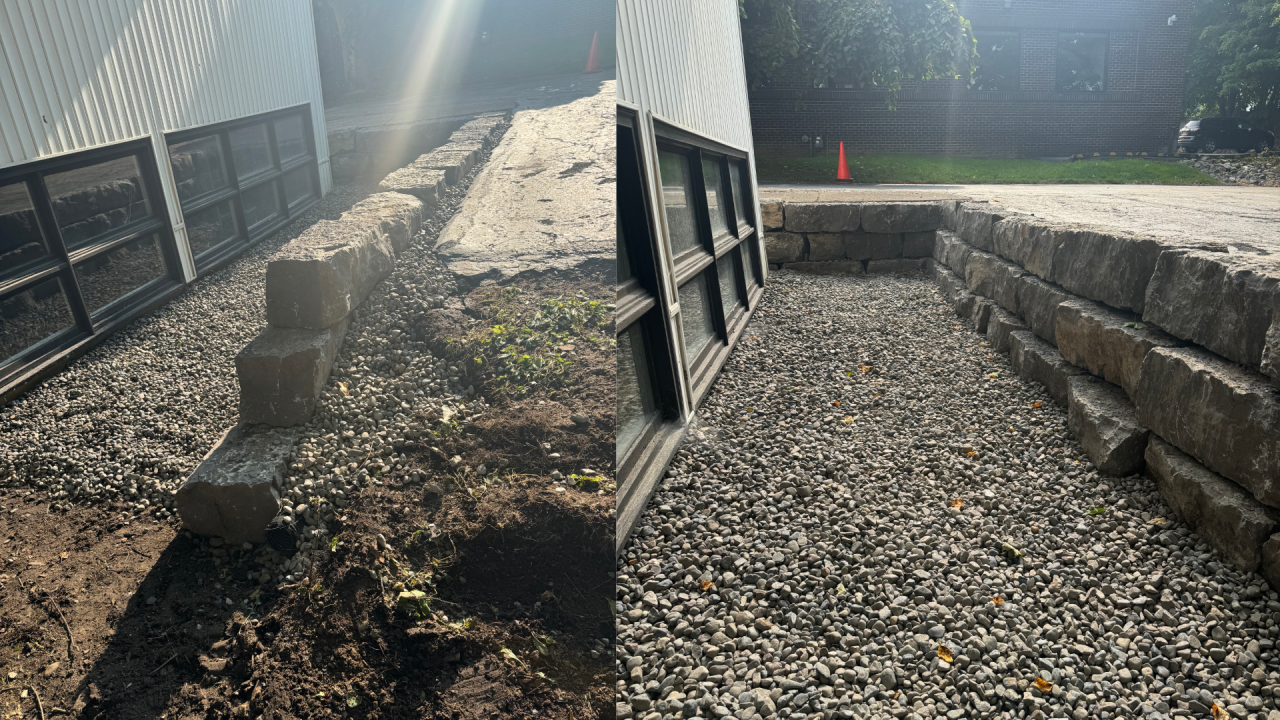
Stop Letting Water Sit Against Your Liverpool House
BLUF: Water sitting against your foundation is one of the most expensive problems a Liverpool homeowner can ignore. A proper drainage system moves water away from your house before it gets a chance to cause damage and the cost of installing one is a fraction of what you’ll spend fixing a wet basement, cracked foundation, or eroded yard that never had one.
Water Is Patient, and It Always Finds the Weak Spot
In my years of working on properties across Onondaga and Oswego Counties, I’ve walked more yards than I can count where the homeowner had no idea water was quietly working against their foundation. It doesn’t announce itself. It seeps. It pools after every rain in the same low spot near the house. It saturates the soil along the foundation wall until the wall cracks, bows, or allows moisture to seep through.
By the time most people call us, the yard has been telling the story for a while, with soggy patches that never fully dry out, a basement that smells musty after a heavy rain, efflorescence on the foundation wall, or erosion channels cutting through the yard every time it storms.
The fix for all of it starts with getting water moving in the right direction. That’s what a drainage system does — and done right, it protects one of the biggest investments you’ll ever make.
Why Liverpool Properties Are Particularly Vulnerable
Clay-Heavy Soil Doesn’t Let Water Go
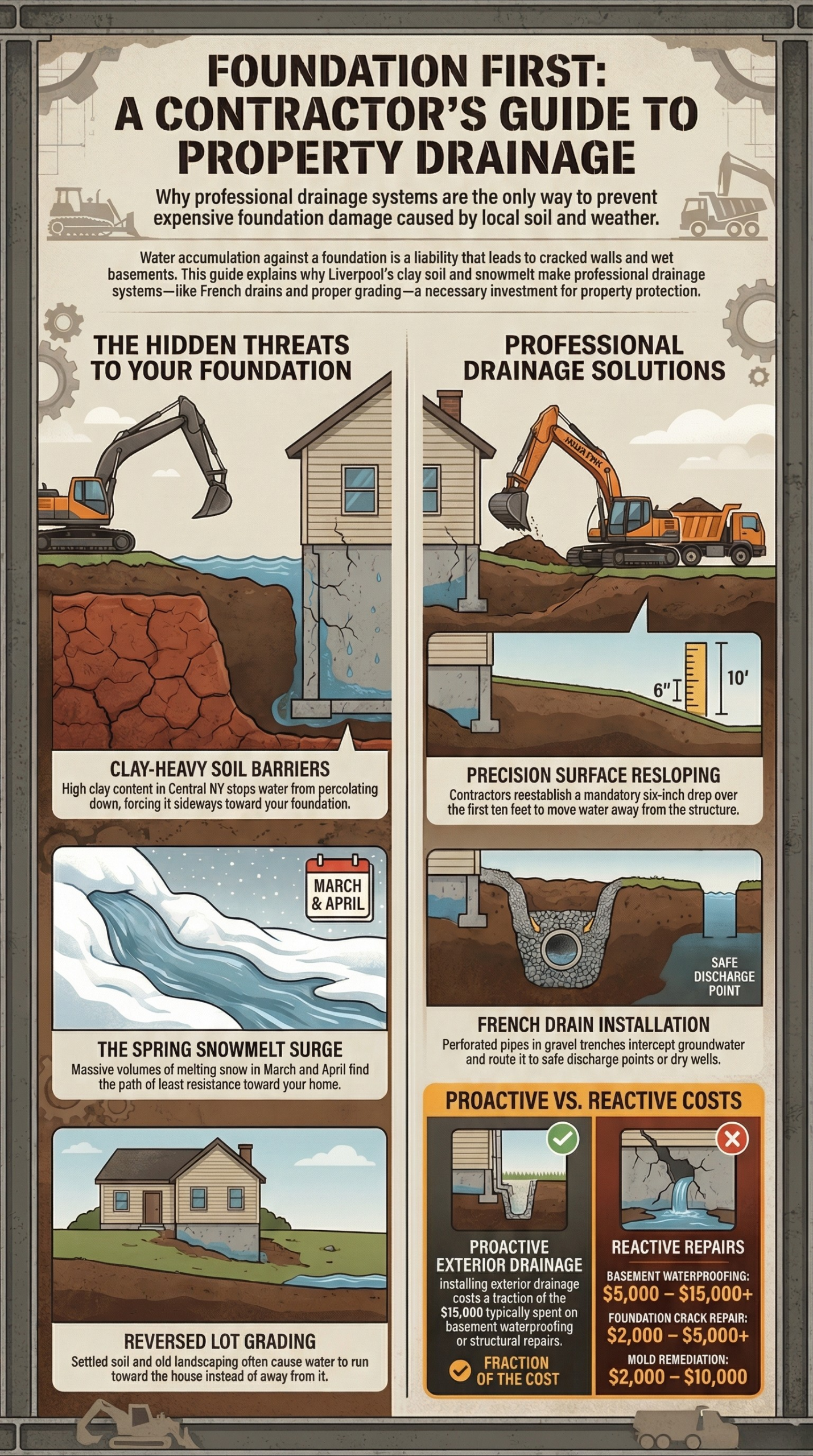
Much of Central New York soil, particularly in Onondaga County, has a high clay content. Clay doesn’t drain. When rain falls or snow melts, water reaches that clay layer and stops moving. It has nowhere to go except sideways, and sideways often means toward your foundation.
This is different from a sandy or loamy yard where water percolates down naturally. If your soil is heavy clay and you don’t have drainage infrastructure in place, you’re fighting the ground itself every spring.
Spring Snowmelt Hits All at Once
Liverpool winters leave significant snow accumulation along the fence lines and in low areas of the yard. When that snowpack melts in March and April, the volume of water hitting the ground in a short window is enormous. A yard without a drainage plan takes all of that water and has no organized way to move it — so it finds the path of least resistance, which is usually straight toward the foundation.
Lot Grading Problems Are Common in Older Neighborhoods
Many Liverpool neighborhoods were developed decades ago, and lot grading wasn’t always done with drainage in mind. Settled soil, added landscaping, and years of freeze-thaw cycles can reverse the slope near a foundation so that instead of water running away from the house, it runs toward it. This is one of the most common issues we find when we assess a property, and homeowners are often surprised because it’s not obvious from a quick look at the yard.
The Drainage Solutions We Install
Surface Grading and Resloping
Sometimes the most direct fix is reshaping the ground itself. If the yard has settled or was graded incorrectly, we reestablish the proper slope away from the foundation, typically a six-inch drop over the first ten feet from the house. This is the baseline for every other drainage solution. Without proper surface grading, even the best underground system won’t perform the way it should.
French Drains
A French drain is a perforated pipe buried in a gravel-filled trench that intercepts groundwater or surface runoff before it reaches the foundation. We install French drains along the perimeter of foundations, at the base of slopes that push water toward the house, and in low areas of the yard that collect standing water.
The water enters the gravel bed, finds the perforated pipe, and gets directed to a discharge point, a daylight outlet at a lower part of the property, a dry well, or a street-side drain. It’s a straightforward system that works quietly and reliably for decades when installed correctly.
Channel Drains and Surface Inlets
For driveways, patios, and hardscape areas where water sheets across a solid surface and has nowhere to go, we install channel drains, linear grates set into the surface at the low point that collect runoff and route it underground to a discharge location. Surface inlets serve the same purpose in yard areas where a single collection point makes more sense than a trench.
Downspout Extensions and Buried Discharge Lines
Gutters and downspouts do their job right up until they dump water six inches from your foundation. We extend downspouts with buried rigid pipe that carries roof runoff well away from the house before it surfaces in the yard. This is one of the lower-cost drainage improvements we make, and the impact on foundation moisture is immediate.
Dry Wells
When a property doesn’t have a natural low point or a street outlet to daylight a drain, we install dry wells, underground chambers filled with gravel that collect water and slowly disperse it into the surrounding soil, away from the foundation. Dry wells work well for roof drainage and yard drainage in properties where running a pipe to the street isn’t practical.
How We Assess and Design a Drainage Solution
We don’t show up and start digging. Before any work begins, we walk the full property and look at where water is coming from, where it’s going, and where it’s getting stuck. That means looking at:
- The slope and grade of the yard in relation to the foundation
- Where downspouts are currently discharging
- Low spots, wet patches, and erosion patterns that tell us where water has been moving
- Existing drainage features — catch basins, gutters, any prior drainage work — and whether they’re functioning correctly
- Soil type and how well it absorbs water naturally
From that assessment, we put together a plan that addresses the actual source of the problem rather than just patching a symptom. In some cases, one solution handles everything. In others, we combine grading with a French drain and downspout routing to give the property a complete system that works together.
We Also Look at What’s Downstream
Good drainage doesn’t just move water away from your house — it moves it somewhere appropriate. We make sure discharge points don’t push water onto a neighboring property, back toward another part of your own yard, or into an area that will create a new problem. The plan has to work for the whole property, not just the area right next to the foundation.
What Poor Drainage Actually Costs You
Homeowners sometimes hesitate on drainage work because it doesn’t feel urgent until something visible fails. Here’s what that hesitation ends up costing:
- Basement waterproofing and interior drain systems — typically $5,000 to $15,000 or more, often needed because exterior drainage was never addressed.
- Foundation crack repair — ranges widely depending on severity, but even minor structural cracks start at several thousand dollars to fix properly.
- Mold remediation in a basement or crawlspace — $2,000 to $10,000 depending on the extent, plus the cost of whatever was damaged.
- Landscaping replacement — eroded slopes, dead grass from waterlogged soil, and washed-out garden beds all need to be redone once drainage is finally corrected.
A proper exterior drainage system installed upfront almost always costs less than any one of those repair bills. We work with homeowners to find the most direct solution that protects the foundation without overbuilding a system the property doesn’t need.
Common Questions From Liverpool Homeowners
“My basement only gets wet a couple times a year. Is drainage still worth it?”
Yes — and that pattern is actually a clear signal that the exterior drainage isn’t managing heavy rain events. Water that gets into the basement even occasionally is doing damage each time it happens. Moisture cycles accelerate mold growth, cause efflorescence on block walls, and eventually work on mortar joints and the wall structure itself. Two or three wet events a year is enough to cause serious long-term damage.
“Will drainage work tear up my yard permanently?”
There’s temporary disruption during installation — we’re digging trenches and moving soil — but we restore the surface grade and reseed disturbed grass as part of the job. Most drainage work is invisible once it’s done. The pipe and gravel are underground. The yard looks normal, drains properly, and you don’t think about it again.
“Can you work around existing landscaping and garden beds?”
We do our best to route drainage around features worth saving, and we tell you upfront where conflicts exist. Sometimes the most effective drainage path runs through an area with plantings, and we’d rather have an honest conversation about that before we start than damage something and have it be a surprise.
“Do we need a permit for drainage work in Liverpool?”
Most residential drainage work — French drains, downspout extensions, regrading — doesn’t require a permit in Onondaga County. Work that ties into municipal storm systems or involves significant excavation near property lines may have different requirements, and we’ll flag them if they apply to your project.
Stop Letting Water Work Against Your Foundation
If your yard holds water after rain, your basement gets damp, or you’ve noticed erosion near the house — those aren’t small issues to deal with later. They’re a drainage system telling you it either doesn’t exist or isn’t working.
We serve Liverpool and communities throughout Onondaga and Oswego Counties. Our assessments are free, and we give you a straight answer about what the property needs rather than upselling a solution that’s bigger than the problem.
Give Ground Force Property Services, LLC a call at 315-461-7747, or schedule your free consultation.