
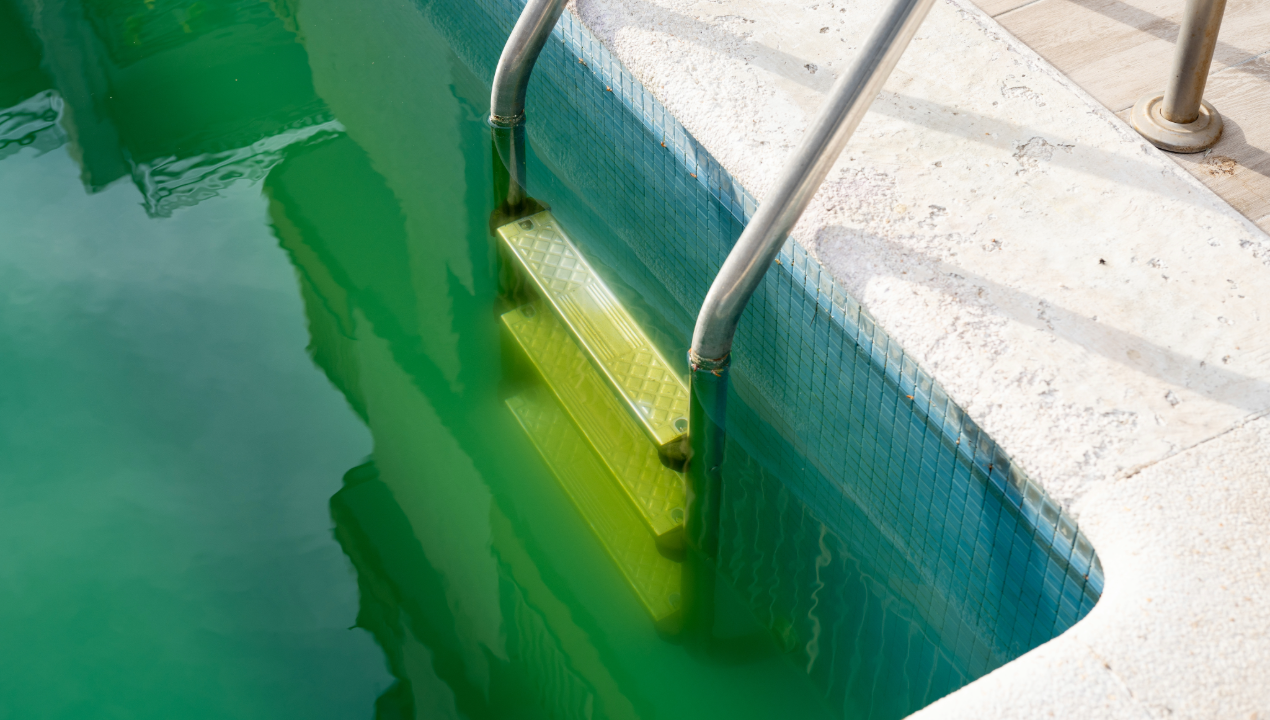
An Old Pool Is A Liability, Not An Asset
BLUF: That old pool sitting in your backyard is not harmless. It is costing you usable space, creating liability, raising safety concerns, and dragging down the value and function of your property. Whether it is an above-ground pool with a rusted frame or an in-ground pool with a cracked shell and failing deck, the problem does not stay frozen in place. It gets worse with every season. In Liverpool, NY, where freeze-thaw cycles, heavy rain, and harsh winters put constant stress on outdoor structures, an aging pool can become a real hazard and a major obstacle when it is time to sell. Removing it is often one of the smartest property decisions a homeowner can make. It gives you your yard back, removes a major maintenance burden, and opens the door to something far more useful, like a paver patio, open lawn, fire pit area, garden space, or a fully reimagined backyard built for how you actually live today.
The Pool That Nobody Uses Anymore
I walk into backyards all the time where the pool has been sitting unused for two, three, sometimes five years. The water is green. The liner is shredded. The above-ground frame is rusting through at the base. Or it’s an in-ground pool with a cracked shell, a failed pump system, and a deck around it that heaved up so badly it looks like a small earthquake hit it.
The homeowner almost always tells me the same thing: “We used it when the kids were young, but they’re grown now. We’ve been meaning to deal with it.”
Meaning to deal with it is costing them money every single year — in insurance premiums, in liability exposure, in maintenance they’re not doing, and in the simple fact that a large portion of their backyard is being held hostage by a structure they don’t want and can’t use.
Pool removal isn’t a last resort. For many Liverpool homeowners, it’s the smartest property decision they can make. This article walks through exactly why — and what your yard can look like once the pool is gone.
The Dangers of an Old Above-Ground Pool
Above-ground pools feel less permanent than in-ground pools, leading many homeowners to underestimate the damage a deteriorating one can cause. The reality is that an old, neglected above-ground pool carries a serious list of hazards — and most of them build silently until something goes wrong fast.
Structural Collapse
Above-ground pools are held together by a system of steel or aluminum uprights, top rails, and a wall panel, usually steel, sometimes resin. When that metal frame starts to rust, which happens aggressively in Central New York’s wet climate and freeze-thaw cycles, the structural integrity of the entire pool degrades. A frame that looks passable from ten feet away can be paper-thin at the base welds. If the pool still has water in it, even partially, a frame failure can release thousands of gallons in seconds.
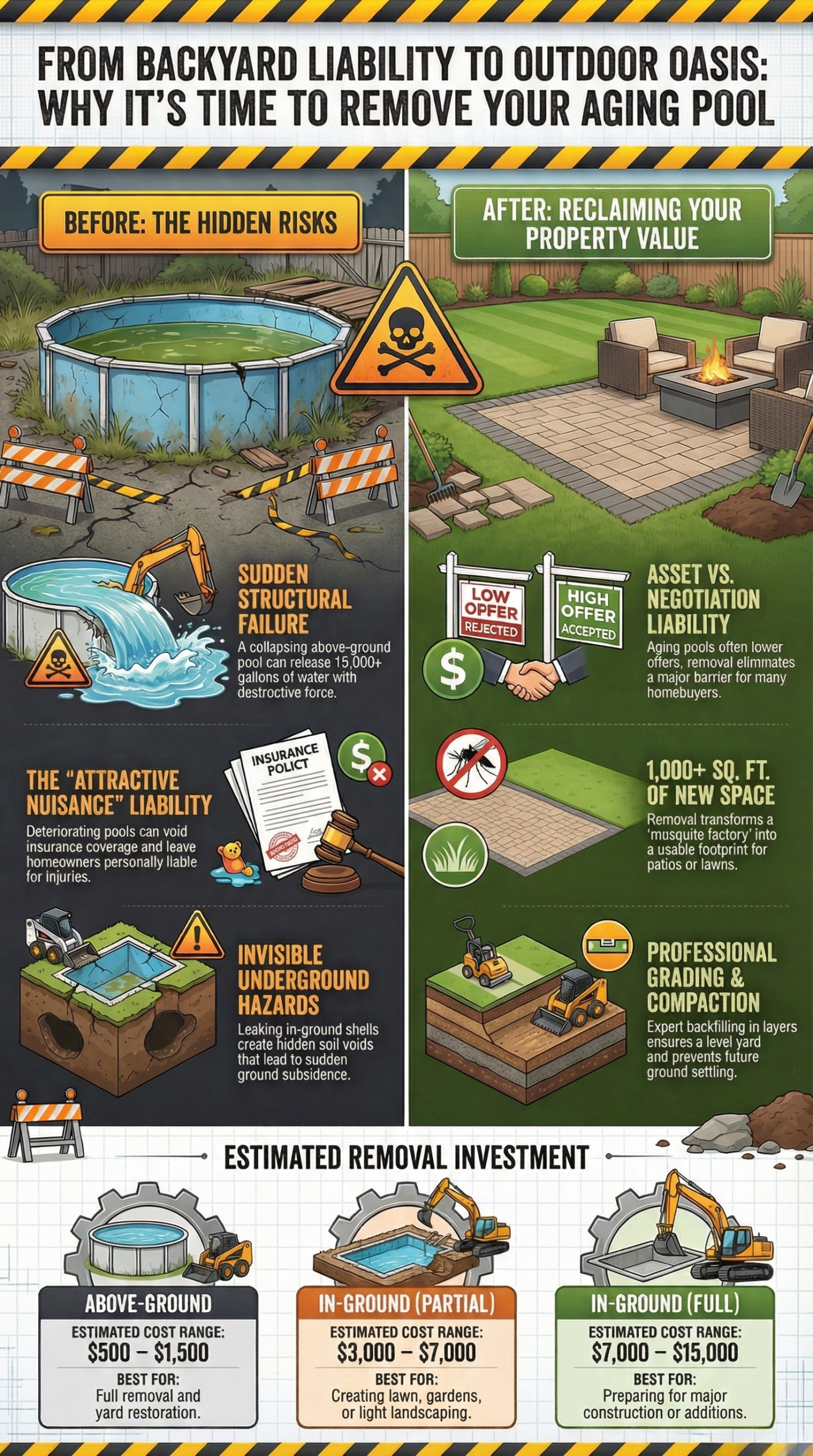
! A partially-filled 24-foot round above-ground pool holds over 13,000 gallons of water. A sudden frame collapse releases that volume with enough force to knock a person off their feet, damage fencing, and flood neighboring property.
We’ve seen frames that looked structurally sound fail during a hard winter freeze because water got into corroded sections, causing them to expand. The failure isn’t always predictable, which is exactly what makes it dangerous.
Drowning Risk and Unsecured Access
Any body of standing water is a drowning hazard, and the risk doesn’t require a full pool. Even two feet of stagnant water in an old above-ground pool is enough to drown a small child. Deteriorating above-ground pools frequently have damaged or missing ladders, broken entry gates, and sagging walls that a child can push through or climb over without the resistance a properly maintained pool would provide.
Homeowners with old, unused above-ground pools often remove the ladder, thinking that eliminates access. It reduces it, it doesn’t eliminate it. A motivated child, or a child who simply doesn’t understand the danger, finds a way in.
Mosquito Breeding and Standing Water
Stagnant water in an unused above-ground pool is one of the most productive mosquito breeding environments a yard can have. A single neglected pool can generate thousands of mosquitoes per week during warm months. Beyond the nuisance, mosquito populations in Central New York carry West Nile Virus, and Onondaga County health authorities actively monitor and address standing water sources for exactly this reason.
Treating the water with chemicals keeps this in check temporarily, but an old pool that’s not being actively maintained almost never gets properly treated — which means it becomes a neighborhood mosquito factory every summer.
Liner Failure and Soil Contamination
Old above-ground pool liners crack, shrink, and develop holes. When the liner fails, pool water containing chlorine, algaecides, and other treatment chemicals leaches directly into the surrounding soil. Over time this affects soil pH, can kill grass and plantings in the surrounding area, and creates a saturated zone near the pool base that contributes to drainage problems on the rest of the property.
Homeowner’s Insurance and Liability
An unused, deteriorating above-ground pool is what insurance companies call an attractive nuisance — a structure that draws people, especially children, toward a hazard they may not recognize as dangerous. Most homeowner’s insurance policies require that pools be properly maintained and secured. A pool that doesn’t meet those standards can void coverage for pool-related incidents, leaving the homeowner personally liable for any injury that occurs on the property.
Some insurers have begun charging additional premiums or requiring proof of proper fencing and maintenance for above-ground pools regardless of use. Removing the pool eliminates that exposure entirely.
The Dangers of an Old In-Ground Pool
In-ground pools carry a different and in many ways more serious set of risks than their above-ground counterparts, because the structure is permanent, harder to monitor, and can cause damage to the surrounding property long before any visible sign of failure appears.
Shell Cracking and Structural Failure
In-ground pool shells, whether concrete, gunite, or fiberglass, are engineered to hold water and resist soil pressure from the outside. When they’re properly maintained and full of water, the internal water pressure helps counteract the pressure of the surrounding soil pushing in. When a pool sits empty or partially drained, that balance is gone.
An empty in-ground pool in saturated soil is under enormous lateral pressure from the surrounding ground. Concrete shells crack. Fiberglass shells can literally pop out of the ground — a phenomenon called pool flotation — when the water table rises, and there’s no water weight inside the pool to hold it down. We’ve seen fiberglass shells lift several inches out of the ground after a wet spring in Central New York.
! Never drain an in-ground pool completely without professional guidance. An empty shell in wet soil is structurally compromised and can crack, shift, or float within hours of a heavy rain event.
Deck Collapse and Trip Hazards
The deck surrounding an in-ground pool, whether poured concrete, pavers, or wood, is designed to be supported by stable soil beneath it. When the pool shell cracks and allows water to escape into the surrounding soil, or when years of freeze-thaw cycles work on the deck surface, the deck can heave, sink, and develop serious trip hazards along its edges.
Cracked pool decks adjacent to open water are one of the most common accident scenarios we hear about. Someone walks out to check on the pool, catches a heaved concrete edge, and falls — either onto the deck or into the pool itself. The older the pool and the more neglected the surrounding deck, the higher the risk.
Electrical Hazards
Every in-ground pool has an electrical system, including pump motors, lighting, and bonding wires running through the pool shell. Old pool electrical systems were not built to current National Electrical Code requirements, and decades of moisture, chemical exposure, and physical deterioration make aged pool wiring a real shock hazard.
Faulty bonding in a pool can cause what’s called electrical water-shock drowning—an imperceptible current running through the water that causes a swimmer to lose muscle control. Even without anyone in the pool, deteriorating pool electrical components near the water are a hazard during rain events and flooding. Old pool lights that leak current into the water are particularly dangerous because there’s no visible warning.
! If an old in-ground pool still has any active electrical connections, do not enter the water under any circumstances. Have the system assessed by a licensed electrician before any contact with pool water.
Underground Structural Voids
One of the less obvious dangers of an abandoned in-ground pool is what happens to the soil around and beneath the shell as it ages. A cracked shell allows water in and out during different seasons. That movement carries soil particles with it over time, creating underground voids — essentially hollow spaces in the soil around the pool structure that aren’t visible from the surface.
These voids can cause sudden ground subsidence, with the surface soil above them collapsing without warning. We’ve seen this happen in yards where the pool itself looked reasonably intact from above, but years of water migration had hollowed out sections of soil beneath the surrounding deck and lawn. Someone walking across the yard steps into a spot that simply gives way.
Failing Retaining Walls and Yard Erosion
Many in-ground pools in Liverpool-area neighborhoods were built with retaining walls or raised deck structures that hold back sloped yard sections. When those structures age without maintenance, the combination of soil pressure, water infiltration, and concrete degradation progressively weakens them. A retaining wall failure next to an in-ground pool is a serious event — it can move large amounts of soil rapidly and create a safety emergency on a property that had given no obvious warning.
Mosquitoes, Algae, and Water Quality
An old in-ground pool that still holds water, even partially, becomes the same mosquito and algae breeding ground as an above-ground pool, but at much larger scale. A standard in-ground pool holds 15,000 to 25,000 gallons. Untreated, stagnant water at that volume supports enormous insect populations and becomes a genuine public health concern, particularly in years when mosquito-borne illness surveillance is active in Onondaga County.
Real Estate and Home Sale Complications
Here’s one that surprises many homeowners: an old, neglected in-ground pool often hurts a home’s resale value rather than boosting it. Buyers look at an aging pool and see cost — replastering, new equipment, deck repair, updated electrical — and discount their offer accordingly or walk away entirely. A pool that was an asset in its prime becomes a liability in negotiations once it shows its age.
Buyers who don’t want a pool at all — and that’s a growing segment of the market, particularly buyers with no children or buyers over 50 — treat an in-ground pool as a negative that has to be priced out before they’ll make an offer. Removing it before you list removes that barrier entirely.
How Ground Force Removes Old Pools
Pool removal is not a demolition-and-dump job. Done right, it’s a planned excavation process that leaves the property in a condition where you can build on it, landscape it, or simply have a flat, usable yard again. We handle both above-ground and in-ground removal across Liverpool and the surrounding area, and we treat every job differently because every property has different soil conditions, access constraints, and plans for the space after.
Above-Ground Pool Removal
Above-ground pool removal is the more straightforward of the two, but it still requires a systematic process:
- We pump out all remaining water and dispose of it appropriately. Pool water treated with chemicals can’t just be discharged anywhere.
- We dismantle the liner, frame, uprights, and top rail system and separate materials for disposal and, where possible, recycling. We handle steel framing, a recyclable metal.
- We assess the ground beneath the pool — years of moisture retention under the liner often leave compacted, low-nutrient soil that needs amendment before grass will grow back.
- We regrade the area and bring in topsoil as needed to restore a proper surface grade that matches the surrounding yard and drains correctly.
- We seed or sod the area based on the homeowner’s desired finished surface.
In-Ground Pool Removal — Full vs. Partial
For in-ground pools, homeowners have two options: full removal or partial removal (also called pool abandonment or fill-in). We walk through both with every homeowner because the right answer depends on your soil, your plans for the space, and whether you intend to sell.
Full removal means the entire pool shell comes out, the concrete is broken up and hauled away, the fiberglass shell is extracted in sections, and all plumbing and electrical are disconnected and removed. The hole is backfilled with clean fill in layers, compacted properly, and the surface is restored. Full removal is the right choice if you plan to build on the space — an addition, a garage, a large patio because partial removal leaves the underground structure that limits what can be constructed above it.
Partial removal means we break up the bottom of the shell to allow drainage, punch holes in the walls if it’s a fiberglass shell, and fill the pool cavity with clean gravel at the base and clean fill above it, compacted in lifts to prevent settling. The shell perimeter remains underground but is no longer a closed structure. This approach costs less than full removal and is appropriate when the space will be used for lawn, gardens, or light landscaping rather than construction.
! Partial removal should always be disclosed to future buyers if you sell the property. In New York State, failing to disclose known underground structures can expose you to legal liability. We document the removal method and fill specs so you have that record.
Permitting and Site Work
Pool removal in Onondaga County typically requires a permit, and we handle that process. We also disconnect and cap all plumbing lines and coordinate electrical disconnection with a licensed electrician before any excavation begins. These aren’t optional steps—they’re part of doing the job correctly and ensuring the property passes inspection.
What to Do With the Space After Pool Removal
This is the part most homeowners haven’t thought through until the pool is gone — and then suddenly they realize how much usable yard they just got back. A standard in-ground pool with its surrounding deck can occupy 1,000 to 2,000 square feet of a backyard. That’s a significant piece of property that can now do something for you instead of just sitting there costing you money.
A Paver Patio With Fire Pit
The most popular conversion we do after an in-ground pool removal is a paver patio often with a built-in fire pit or a standalone fire feature. The footprint where the pool and deck used to be is already cleared and roughly level. Properly compacted fill makes an ideal base for paver installation. We’ve turned former pool areas into stunning outdoor living spaces that homeowners use far more than they ever used the pool.
Lawn Restoration
Sometimes the right answer is simple: grass. A flat, well-seeded lawn where a pool used to be gives the yard back its open feel, is easy to maintain, and makes the property more appealing to a broad range of buyers if you plan to sell. We restore the grade, amend the soil, and seed or sod to get the lawn established.
Garden Beds and Landscape Features
The cleared space is a clean slate for planting. Raised garden beds, native plantings, a kitchen garden, ornamental trees — all of it is possible once the pool is gone and the soil is properly prepared. We work on grading and drainage to ensure the former pool area doesn’t become a wet spot that drowns plantings every spring.
Outdoor Kitchen or Living Structure
For homeowners who want a full outdoor room, the space left by a pool removal is an excellent footprint for a hardscaped outdoor kitchen area, a pergola base, or a covered outdoor living structure. We work with the excavation and compaction specs that make the ground suitable for that kind of use.
Expanded Yard for Kids or Pets
For families with young children or dogs, the single most practical use of the space is simply more open yard. Room to run, play, and move around without the hazard of an open body of water sitting in the middle of it. We’ve had parents tell us pool removal was the best safety decision they made for their kids — ironically, the thing they built for the kids became the thing they needed to remove to keep them safe.
Questions Liverpool Homeowners Ask Before Pool Removal
“How much does pool removal cost in the Liverpool area?”
Above-ground pool removal typically runs from $500 to $1,500, or more, depending on size, accessibility, and the condition of the liner and frame. In-ground pool removal varies more widely — partial removal generally runs $3,000 to $7,000, and full removal typically runs $7,000 to $15,000, depending on pool size, shell material, depth, and site access for equipment. We give firm estimates after a property visit because no two pools are in the same condition.
“Will the ground settle after pool removal?”
With proper backfill and compaction, settling is minimal. We compact fill in lifts — thin layers, each compacted before the next goes in — rather than dumping fill all at once and hoping it holds. That’s the difference between a yard that stays level and one that develops a sinkhole over time. We also advise homeowners to wait a full season before installing any hardscaping over a former pool area to let the fill fully settle.
“Can we install a patio right away after removal?”
For paver patios and landscaping, we typically recommend waiting three to six months after partial removal to allow the backfill to settle fully. For full removal with properly compacted structural fill, hardscaping can often go in sooner. We provide specific guidance based on how the removal was performed and the plans for the space.
“Do we need to tell buyers the pool was there?”
Yes. In New York State, known material facts about a property must be disclosed to buyers. A removed pool — particularly a partial removal where underground structure remains — is a material fact. We provide documentation of the removal method, fill specifications, and permit closure so you have a complete record to share. This protects you legally and gives buyers the information they need to proceed with confidence.
Ready to Get Your Yard Back?
If you have an old pool sitting unused in your Liverpool backyard, the conversation about removing it is worth having sooner rather than later. Every season it sits there —it’s costing you—in liability, insurance, maintenance, and the simple fact that your yard could be something better.
We serve Liverpool and communities throughout Onondaga and Oswego Counties. Our estimates are free and straightforward — we come out, look at the pool and the property, and tell you exactly what removal would involve and what it would cost. No pressure, no runaround.
Give Ground Force Property Services, LLC a call at 315-461-7747, or schedule your free consultation.