
BLUF: If water keeps sitting in your yard, running toward your foundation, drowning your grass, making your patio slimy, or turning your backyard into a swamp every spring, the problem usually does not fix itself. In Onondaga and Oswego Counties, drainage issues worsen due to heavy soils, freeze-thaw cycles, snowmelt, rain, grade changes, and older properties that were never set up to move water properly. Cornell notes that silt and clay soils slow water and air movement and hold more water, which is a big reason some Central New York yards stay wet longer than homeowners expect. Onondaga County planning materials also note the county’s 19 towns and 15 villages, while Oswego County’s municipalities page shows its towns, villages, and cities across a largely rural county.
The straight truth is this. If your yard cannot drain, nothing else in that yard works the way it should. Not the lawn. Not the patio. Not the fire pit area. Not the walkway. Not the foundation plantings. Not the outdoor living space you are trying to enjoy. A good drainage plan, whether that means a French drain, catch basin, channel drain, grading correction, downspout extensions, or a full water management setup, can change how the whole property feels. And when Ground Force Property Services does it right, they are not just moving water. They are giving you a backyard that finally works.
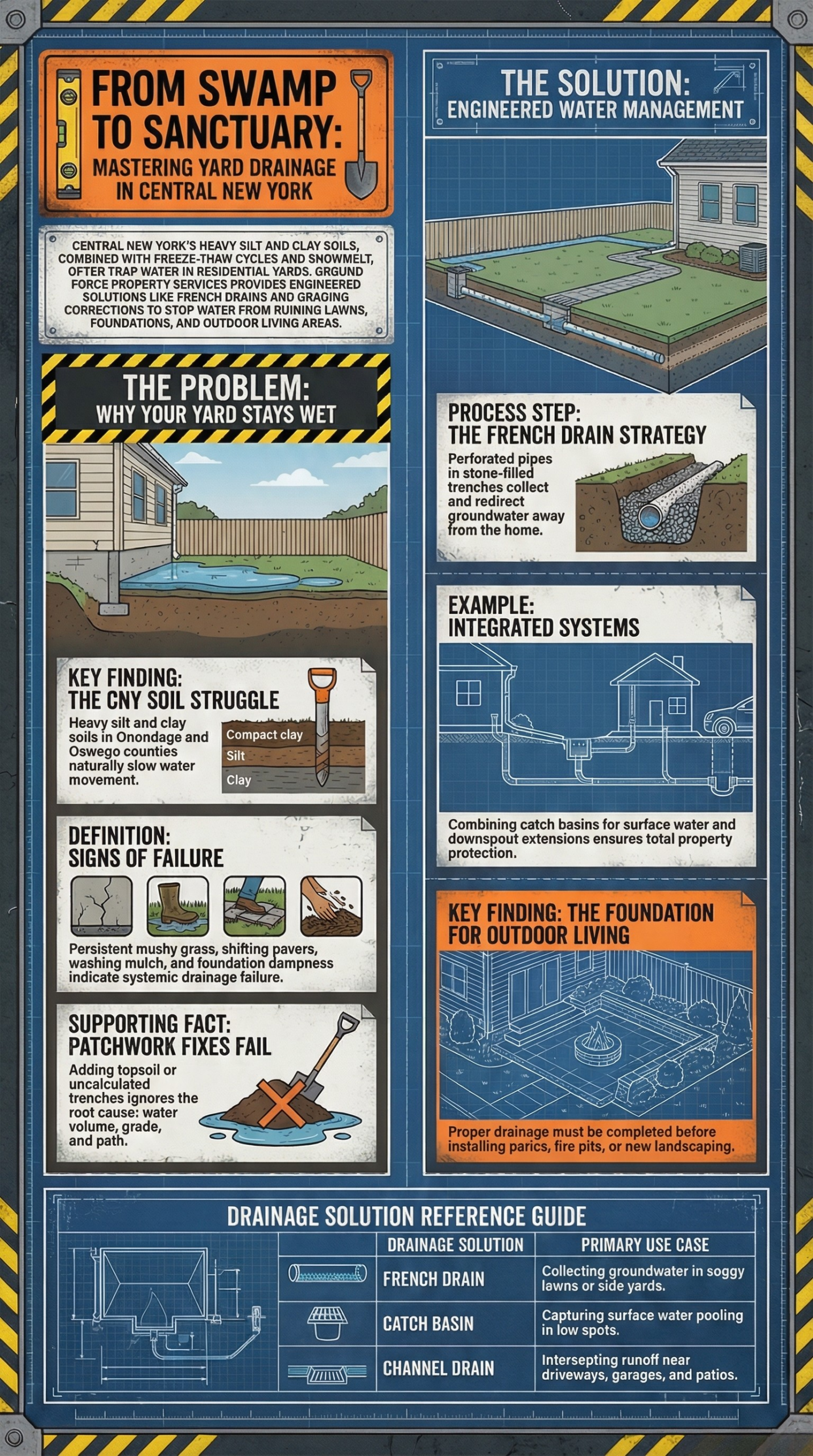
Table of Contents
- Chapter 1: Why drainage problems are so common in Central New York
- Chapter 2: What a French drain actually does
- Chapter 3: Other drainage systems homeowners should know about
- Chapter 4: Onondaga County town by town drainage challenges
- Chapter 5: Oswego County town by town drainage challenges
- Chapter 6: Signs your yard needs a real drainage solution
- Chapter 7: Why patchwork fixes usually fail
- Chapter 8: How Ground Force Property Services can turn a wet yard into usable space
- Chapter 9: Final thoughts and next step
Chapter 1: Why drainage problems are so common in Central New York
Let’s keep this simple.
If you live in this part of New York, you already know water has a way of hanging around where you do not want it. Spring thaw. Heavy rain. Saturated ground. Snowmelt. Runoff from neighboring lots. Water rolling off the roof. Water coming across the driveway. Water collecting at the low corner of the backyard. Water finding the same bad spot over and over again.
Then summer hits and you think it might dry out.
Sometimes it does.
Sometimes it turns into muddy grass, mosquito breeding, foundation dampness, rotting fence posts, slippery patios, washed out mulch beds, and an outdoor space that always feels a little half broken.
That is the part homeowners get tired of. Not one huge flood event. The constant annoyance of a property that never quite dries right.
A lot of yards in this region are fighting more than one issue at once.
- The soil may already hold water.
- The lot may pitch the wrong way.
- The downspouts may dump too close to the house.
- The backyard may have low spots.
- The patio may trap runoff.
- The driveway may funnel water into the lawn.
- The old drainage may be undersized, clogged, or useless.
The result is always the same. Water wins.
And once water starts winning, the rest of the yard starts losing.
- Grass thins out.
- Mud spreads.
- Pavers shift.
- Walkways settle.
- Mulch floats.
- Basement worries grow.
You stop enjoying the yard because you are always managing the mess.
That is why drainage is not some minor side issue. It is the thing that decides whether the property feels solid or sloppy.
Chapter 2: What a French drain actually does
A lot of people have heard the term French drain, but they are not always sure what it means.
Here is the plain language version.
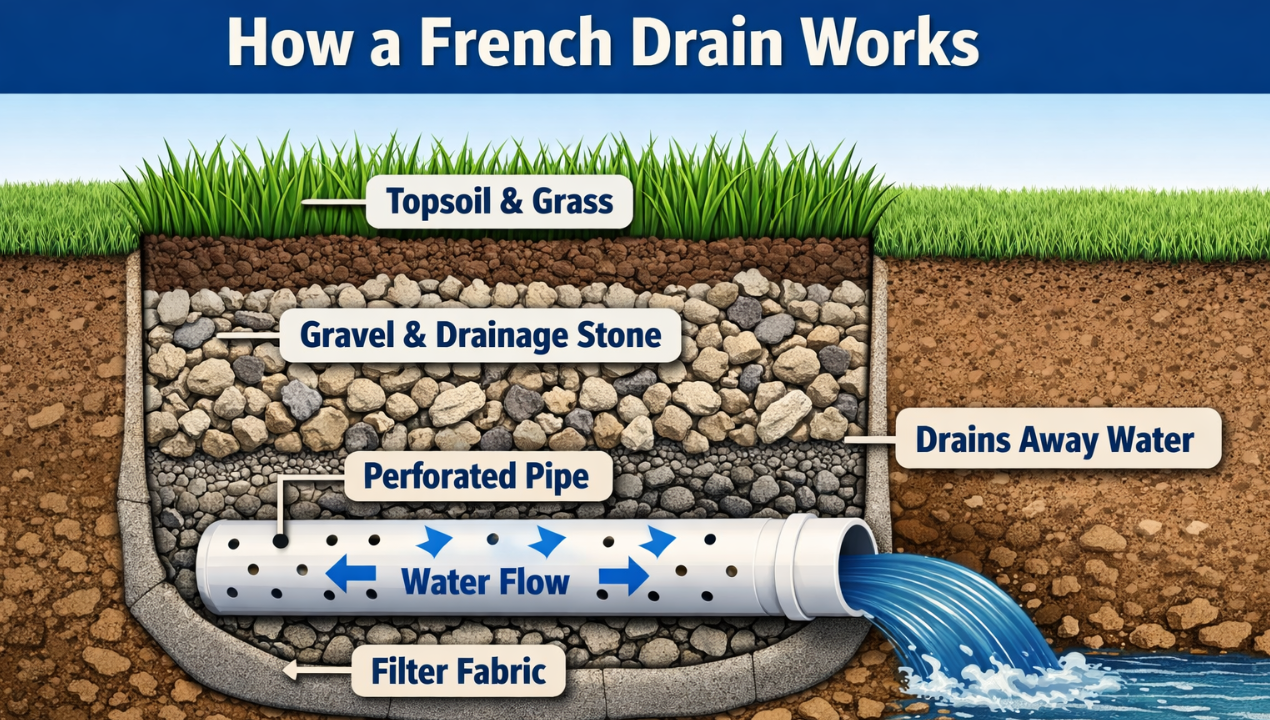
A French drain is a way to collect water in the ground and move it somewhere better.
Usually that means a trench with stone and a perforated pipe inside it. Water enters the trench, gets picked up by the system, and is directed away from the area that keeps staying wet. That might be away from the house. Away from a patio. Away from a soggy lawn section. Away from a side yard where water keeps pooling.
It is not magic.
It is controlled water movement.
That is what makes it so useful.
A French drain can help with:
- Wet lawns
- Soggy side yards
- Water near foundations
- Runoff along fence lines
- Pooling behind retaining walls
- Drainage trouble near patios
- Areas where water sits after rain
But here is the important part.
A French drain is only as good as the plan behind it.
If the slope is wrong, the outlet is wrong, the trench is shallow, the stone is wrong, the pipe layout is wrong, or the water has nowhere good to go, the drain will disappoint you.
That is where a lot of bad drainage projects come from. Somebody installs a thing without solving the actual water path.
So yes, French drains work.
But only when they are designed for the real problem, not just tossed in because the term sounds familiar.
Chapter 3: Other drainage systems homeowners should know about
Not every yard problem needs the exact same solution.
Sometimes a French drain is right.
Sometimes it is only part of the answer.
Here are the other systems and corrections homeowners should know about.
Catch basins
These are useful when surface water is collecting in a predictable low spot. A catch basin grabs that water and sends it through piping to a discharge point.
Channel drains
These are often used near driveways, garage doors, patios, and hardscape edges where water runs across a surface and needs to be intercepted fast.
Downspout drainage extensions
A shocking amount of water trouble starts at the roofline. If downspouts are dumping too close to the foundation or right into landscape beds, you are basically feeding the problem every time it rains.
Grading correction
Sometimes the most important fix is not a drain. It is reshaping the land so water stops settling where it should not. If the yard pitches toward the house, no fancy system will fully save you until that is addressed.
Dry creek beds
These can work well in the right setting when you need to move visible surface water in a way that looks natural and ties into the landscape.
Drainage tied into hardscape design
This is the smart move a lot of homeowners miss. If you are installing a patio, walkway, or outdoor living area, drainage should be built into the plan from day one. Otherwise you end up with a beautiful new surface and the same old water problem.
That is why the best drainage work is not about throwing one product at the issue. It is about understanding how the whole property handles water.
Chapter 4: Onondaga County town by town drainage challenges
Onondaga County planning materials describe the county as including 19 towns and 15 villages. That matters because drainage problems show up differently across suburban neighborhoods, village lots, and more rural properties.
Camillus
In Camillus, including the Village of Camillus, a lot of drainage trouble shows up in older neighborhoods with mature trees, settled yards, and outdoor spaces that have been modified over time. One change here, one patch there, one deck addition, one patio extension, and suddenly the yard does not move water cleanly anymore. Wet lawn edges and runoff toward patios are common frustrations.
Cicero
Cicero homeowners often deal with flatter yard areas where water has no urgency. It lands, sits, and spreads. That is how you end up with puddling near fence lines, soft backyard corners, and soggy stretches that never seem to recover. A French drain or catch basin setup often makes more sense than trying to reseed the same wet grass every year.
Clay
Clay has plenty of neighborhoods where the backyard should feel easy to use, but poor drainage turns it into work. If water settles around patios, sheds, play areas, or rear property lines, homeowners start losing usable space. In places like this, drainage fixes are often the real beginning of a backyard upgrade.
DeWitt
In DeWitt, where many properties are well kept and established, drainage issues stand out fast. Water near foundations, wet mulch beds, and runoff across walkways can make an otherwise nice yard feel poorly maintained. A good drainage system helps protect both the appearance and function of the property.
Elbridge
Elbridge and the Village of Elbridge can bring larger lots and more open yards, which sometimes fools homeowners into thinking drainage will sort itself out. It does not. Bigger yards can still have bigger low spots, longer runoff paths, and water that lingers where nobody wants it. The right system often starts with finding where the water naturally wants to go and helping it get there.
Fabius
Fabius and the Village of Fabius often mean rolling ground and more rural conditions. That can create runoff issues instead of just pooling issues. Water may move across the property too aggressively in one storm and then leave soggy ground behind afterward. These yards often need both drainage control and grading strategy.
Geddes
Geddes homeowners often feel drainage problems more quickly because backyard space can be tighter. A wet strip along the house or a muddy rear corner is not just annoying. It can take up a meaningful part of the usable yard. In a smaller property footprint, smart drainage planning matters even more.
LaFayette
LaFayette yards often deal with weather exposure and elevation changes. Water may gather at lower points or move downhill into spots that stay soft for days. If the property has old walkways or patios, drainage issues can start causing settlement and uneven surfaces too.
Lysander
Lysander and nearby Baldwinsville area properties often include family backyards that need to serve multiple purposes. If the yard is always wet, everything gets harder. Kids track mud in. The dog tears up the lawn. The fire pit area stays mushy. The patio edges collect runoff. This is where drainage improvements make the whole yard feel more livable.
Manlius
Manlius, along with Fayetteville and Minoa, has many attractive properties where water issues become especially frustrating because the rest of the yard may already look good. A drainage problem in a nice yard feels like a stain on the whole property. French drains, discreet catch systems, and good grading can solve problems without making the yard look overbuilt.
Marcellus
Marcellus and the Village of Marcellus often bring that practical Central New York mindset. Homeowners want a yard that works. If the side yard is always wet, the basement corner feels damp, or the backyard becomes a mud pit in spring, they want a fix that actually lasts. This is a strong market for real drainage work, not quick patch jobs.
Onondaga
The Town of Onondaga has plenty of properties where water movement around the home matters just as much as what happens farther back in the yard. When runoff is moving toward the house, pooling near the foundation, or making side yard access messy, the drainage problem becomes too big to ignore.
Otisco
Otisco properties can be more open and natural, which often means more water movement from surrounding land, more leaf debris, and more uneven drainage patterns. If the lot already wants to hold water, a drainage plan can make a huge difference in usability.
Pompey
Pompey properties often deal with grade changes and more varied terrain. That can create complicated drainage problems, especially when runoff from higher parts of the lot ends up in the wrong place. In these settings, the solution usually needs to be tailored to the land, not copied from a flat suburban yard.
Salina
Salina, including nearby Liverpool and North Syracuse areas, often has properties where water problems show up in side yards, around walkways, and at the back edges of homes. Because convenience matters in these neighborhoods, homeowners usually want a fix that keeps the yard cleaner, safer, and easier to use without turning it into a construction zone forever.
Skaneateles
Skaneateles and the Village of Skaneateles often bring a higher expectation for how a property should look and function. Standing water, washed out beds, or runoff cutting through lawn areas feels especially out of place in a well kept setting. Good drainage work here should solve the problem while keeping the property looking clean and intentional.
Spafford
Spafford has beautiful land, but beautiful land can still hold water in all the wrong places. Sloped lots, natural runoff, and less predictable yard layouts mean drainage systems often need to work with the landscape instead of fighting it.
Tully
Tully knows wet springs and hard winters. If a yard already has soft ground, standing water, or poor runoff control, the season changes will keep exposing the same weaknesses. That is why many homeowners here benefit from addressing the root drainage issue instead of redoing the same damaged areas every year.
Van Buren
Van Buren homeowners often hit the same wall. They keep repairing the symptoms. New seed. More topsoil. More mulch. Another patch at the patio edge. Another try at reshaping the lawn by hand. But if the water path has not changed, none of that holds for long. That is when proper drainage starts making sense.
Chapter 5: Oswego County town by town drainage challenges
Oswego County’s official municipalities page shows a broad mix of towns, villages, and cities across a county that is largely rural in character. That matters because drainage issues here often involve more exposure, more runoff travel, and tougher weather patterns.
Albion
Albion properties often face the challenge of open ground, weather exposure, and wet periods that linger. A yard may dry unevenly, with one section looking fine and another staying soft and messy. Drainage work here often focuses on reclaiming space homeowners have given up on.
Amboy
Amboy can bring wider open lots and strong runoff patterns. Water does not always stay neatly in one corner. It may move across the yard, through gravel, across lawn, and toward outbuildings or lower areas. A full drainage plan matters more than a one spot fix.
Boylston
Boylston homeowners usually value simple, durable property improvements. If the yard stays wet, access gets sloppy, or standing water becomes a recurring spring issue, a French drain or catch basin system can provide the kind of practical solution that actually improves everyday life.
Constantia
Constantia, along with the Village of Cleveland nearby, can deal with moisture, flatter sections, and water that loses momentum and collects. This is the kind of place where wet lawns, muddy transitions, and soggy backyard sections can become normal unless the property is taught where to send water.
Granby
Granby homeowners often want backyards that work for family use. But if water sits around patios, lawn edges, or rear yard gathering spaces, the whole setup feels compromised. Drainage fixes here often unlock the rest of the yard.
Hannibal
Hannibal and the Village of Hannibal know how quickly weather can work against a property. A wet yard plus snowmelt plus poor grading is a bad combination. Water keeps showing up in the same trouble spots until somebody changes the flow pattern.
Hastings
Hastings has properties where runoff from roads, driveways, neighboring ground, or broad lawn areas can create frustrating low spots. Once those spots establish themselves, they tend to stay wet year after year. A drainage solution here is often about breaking that cycle.
Mexico
Mexico and the Village of Mexico can deal with real exposure to weather and broad stretches of yard where water moves in ways homeowners did not expect when the property was dry. If the yard turns soft every thaw and every heavy rain, it needs more than a cosmetic fix.
Minetto
Minetto properties often benefit from drainage improvements because water issues can interfere with how homeowners actually want to use the yard. A muddy route from the house to the backyard or a wet area near outdoor seating becomes a daily annoyance fast.
New Haven
New Haven homeowners often face the simple reality that if the land holds water, the yard never quite performs. Grass struggles. Surface conditions stay soft. Hardscape areas can get undermined. These are the kinds of properties where drainage becomes the first improvement that makes every other improvement possible.
Orwell
Orwell often means more rural property conditions and fewer forgiving surfaces. If the ground stays wet, the problem is not hidden. You see it in ruts, mud, runoff paths, and damaged lawn sections. A serious drainage fix can stabilize a property in a big way.
Oswego town and City of Oswego
The Town of Oswego and the City of Oswego deal with the combined reality of weather exposure, snow, wind, and runoff management. Water problems here can be persistent, especially if old hardscape, tired grading, or undersized drains are part of the picture. Homeowners often need a complete look at how water gets from the roof and yard to a safe exit point.
Palermo
Palermo gives homeowners room to think bigger. That is good news when drainage is the issue. Instead of only solving one puddle, the property may benefit from an integrated system that includes grading, drain lines, and a plan for future outdoor living features.
Parish
Parish and the Village of Parish often bring the kind of yard issues homeowners feel every time they step outside. Mud at the gate. Water along the foundation. Soggy grass where people should be walking. In these settings, drainage work creates immediate quality of life improvement.
Redfield
Redfield knows hard seasons. When a yard already drains poorly, winter and spring will keep exposing that weakness. If you are seeing repeat washouts, standing water, or boggy conditions, the land is telling you it needs help.
Richland
Richland, with places like Pulaski and Lacona nearby, gets the full force of seasonal weather. A wet yard here can stay wet longer than expected, and exposed properties can see runoff behave more aggressively. French drains and grading work often make a big difference in restoring order.
Sandy Creek
Sandy Creek and the Village of Sandy Creek often deal with exposed conditions where water can both move hard and settle badly. That is an annoying mix. It means one storm may carve channels and the next leaves standing water behind. These yards benefit from a plan that controls both movement and collection.
Schroeppel
Schroeppel and Phoenix area properties often have family yards that need to function well every day. If the lawn is constantly wet or the side yard becomes a mud corridor, everything about the property feels less usable. Drainage improvements here often have a direct, visible payoff.
Scriba
Scriba homeowners may find that water issues limit what they can do next. Want a patio? Fix drainage first. Want a fire pit area? Fix drainage first. Want a cleaner lawn? Fix drainage first. Water control is often the step that makes the rest of the yard possible.
Volney
Volney and nearby Fulton area properties often show drainage trouble in repeated surface wear. Soft lawn areas, standing puddles, eroded edges, and poor transitions are all clues that the yard is not moving water correctly. Good drainage work can change the feel of the whole property.
West Monroe
West Monroe often brings open ground and a lot of exposure. Water may collect in broad shallow areas instead of one obvious puddle. That makes the yard feel generally wet instead of clearly flooded. A drainage system can help dry out the property in a much more consistent way.
Williamstown
Williamstown homeowners know that if you do not control water, water will control the property. Between weather, soil conditions, and open lot exposure, drainage issues can become a repeating frustration. A real solution is often worth far more than one more season of frustration.
Central Square, Cleveland, Pulaski, Phoenix, Lacona, and the other villages
In Oswego County villages, space planning matters. When lots are tighter, one wet zone can affect the whole backyard. That is why drainage work in village settings often needs to be efficient, thoughtful, and built around how homeowners actually move through the property.
Chapter 6: Signs your yard needs a real drainage solution
A lot of homeowners wait too long because they keep hoping the problem is seasonal.
Here are the signs the yard needs a real fix.
- Water sits for days after rain
- The lawn is always mushy in the same areas
- You cannot mow certain parts without leaving tracks
- Mulch washes out again and again
- Patio edges stay wet or slimy
- Pavers or walkways are shifting
- Water collects near the foundation
- Downspouts dump into puddles
- The side yard turns into a mud lane
- Mosquitoes get bad because water never fully leaves
- Grass keeps dying in wet spots
- You keep adding dirt but the problem returns
Those are not random annoyances.
Those are the yard telling you it has a drainage problem.
Chapter 7: Why patchwork fixes usually fail
This is where people lose money. They try one small thing. Then another. Then another.
- More topsoil.
- A little trench with no plan.
- A plastic pipe from the hardware store.
- A splash block.
- A few bags of stone.
- Some seed.
- A gutter extension that ends too soon.
Then the next storm comes and nothing really changes.
Why?
Because water follows grade, volume, and path.
It does not care what you hoped would happen.
If the property still feeds water into the same bad area, the problem stays alive.
That is why patchwork drainage fixes often fail. They deal with the symptom, not the route.
A real solution starts with questions like these.
- Where is the water coming from
- How much of it is surface water versus roof runoff
- What areas are lowest
- What surfaces are trapping water
- What can be regraded
- Where can water safely discharge
- What future hardscape or outdoor living plans should be considered now
That last one matters.
Because if you know you want a patio, walkway, fire pit, or backyard living area later, the drainage work should support that plan now. Otherwise you pay twice.
Chapter 8: How Ground Force Property Services can turn a wet yard into usable space
This is the part that matters most to homeowners.
You do not want a science lesson.
You want a yard that works.
That is where Ground Force Property Services comes in.
They can look at the property, understand how the water is behaving, and help build a drainage solution that actually fits the site. That may include French drains, catch basins, grading corrections, runoff control, downspout drainage, or integrated systems tied into the rest of the yard plan.
And here is what makes that especially valuable.
Drainage is not the end of the story.
It is the beginning of a better yard.
Once the water problem is under control, now the fun part starts making sense.
- Now a paver patio has a solid future.
- Now a fire pit area is not sitting in a wet zone.
- Now the walkway stays cleaner and more stable.
- Now the lawn has a chance.
- Now the side yard does not feel like a swamp.
- Now the backyard becomes usable instead of unpredictable.
That is the smartest way to think about drainage.
Not as a hidden utility project.
As the thing that makes the rest of your property worth doing right.
Ground Force Property Services can help turn a yard that has been frustrating you for years into one that feels finished, comfortable, and dependable. French drains and drainage systems solve the problem below the surface. Patios, walkways, pavers, and outdoor living features transform what you see every day.
That is a good combination.
Chapter 9: Final thoughts and next step
If water keeps showing up where it should not, stop hoping it will magically get better.
It usually does not.
In Onondaga County and Oswego County, water problems tend to repeat because the same soil, slope, weather, and runoff patterns keep coming back. If the yard has poor drainage today, next spring will probably remind you again.
And again.
And again.
That is why getting ahead of the issue matters.
A real drainage solution can protect your lawn, patio, foundation, and outdoor living plans. More than that, it can change how the whole yard feels. Cleaner. Drier. More usable. Less frustrating.
Across Camillus, Cicero, Clay, DeWitt, Elbridge, Fabius, Geddes, LaFayette, Lysander, Manlius, Marcellus, Onondaga, Otisco, Pompey, Salina, Skaneateles, Spafford, Tully, and Van Buren, and across Albion, Amboy, Boylston, Constantia, Granby, Hannibal, Hastings, Mexico, Minetto, New Haven, Orwell, Oswego, Palermo, Parish, Redfield, Richland, Sandy Creek, Schroeppel, Scriba, Volney, West Monroe, and Williamstown, homeowners are dealing with the same basic truth.
If the water is wrong, the yard is wrong.
In Summary
If your yard stays wet, your lawn keeps getting torn up, your patio edges collect runoff, or water keeps finding its way toward the house, talk to Ground Force Property Services.
Have them look at the property.
Have the honest conversation.
- Where is the water coming from
- Why is it staying
- What kind of drainage system makes sense here
- What could this yard become once the problem is fixed
Because once the water is under control, everything else in the backyard starts getting easier.
Give Ground Force Property Services, LLC a call at 315-461-7747,